
- Key Takeaways
- The Slate Quarrying Process
- Global Slate Production
- Quarrying Versus Mining
- The Human Element
- Judging Slate Quality
- A Sustainable Future?
- Advocate for environmentally friendly quarrying practices and reduced waste in slate production
- Support research into alternative uses for waste rock and unusable slate
- Encourage the adoption of renewable energy and water recycling in slate factories and quarries
- Promote the role of natural slate as a sustainable, long-lasting building material for future generations
- Conclusion
- Frequently Asked Questions
- What is slate quarrying?
- How is slate different from other quarried stones?
- Where is slate most commonly quarried worldwide?
- How do quarry workers judge slate quality?
- What is the difference between quarrying and mining slate?
- Is slate quarrying environmentally sustainable?
- What are the main risks for people working in slate quarries?
Key Takeaways
- Slate quarrying uses a phased, technical workflow that flows from geological surveys and deposit mapping to block extraction, slab sawing, splitting, trimming, and final inspection. Every stage has to be optimized to preserve the stone’s inherent structure and minimize waste. Readers can translate this insight by requesting that suppliers describe how their slate is quarried and what quality controls are employed at each stage.
- World slate production remains rooted to historic centers in Europe, North America, and South America, and each region provides unique shades, textures, and performance influences that impact design and cost. Architects, builders, and buyers can apply this regional knowledge to choose slates that meet both technical and aesthetic objectives while optimizing for transport distance and cost.
- The choice between surface quarrying and underground mining is driven by geology, depth of slate veins, and economics. Each option carries different environmental, safety, and cost profiles. Project planners and policymakers can use these differences to evaluate suppliers, favoring operations that demonstrate responsible land management, lower energy use, and strong worker protections.
- Slate quarrying has profound social and cultural impacts on local communities, offering jobs and community input while posing environmental and health risks that require open oversight. Readers among planners or procurers can champion community-centric initiatives by asking for public participation, heritage conservation, and site restoration plans.
- Best slate quarry, Judging slate quality, Slate for roofing, structural slates, high traffic floor slates, Slate, roofing, stone, slate quarries, quarrying slate, quarry, slate quarrying, slate rock, rock, slate and stone, quarry, rock quarry, slate slate. Builders and designers can use actionable checklists and certification standards to ensure slate products correspond to climate, load, and design life.
- A sustainable slate future lies in minimizing waste, reclaiming quarries, recycling water and energy, discovering new uses for by-products, and embracing slate’s decades-long performance as a maintenance-free commodity. Anyone with buying power can proactively seek out suppliers that monitor their environmental impact, utilize renewable energy, and provide transparent sustainability reporting to encourage responsible slate usage across the globe.
===
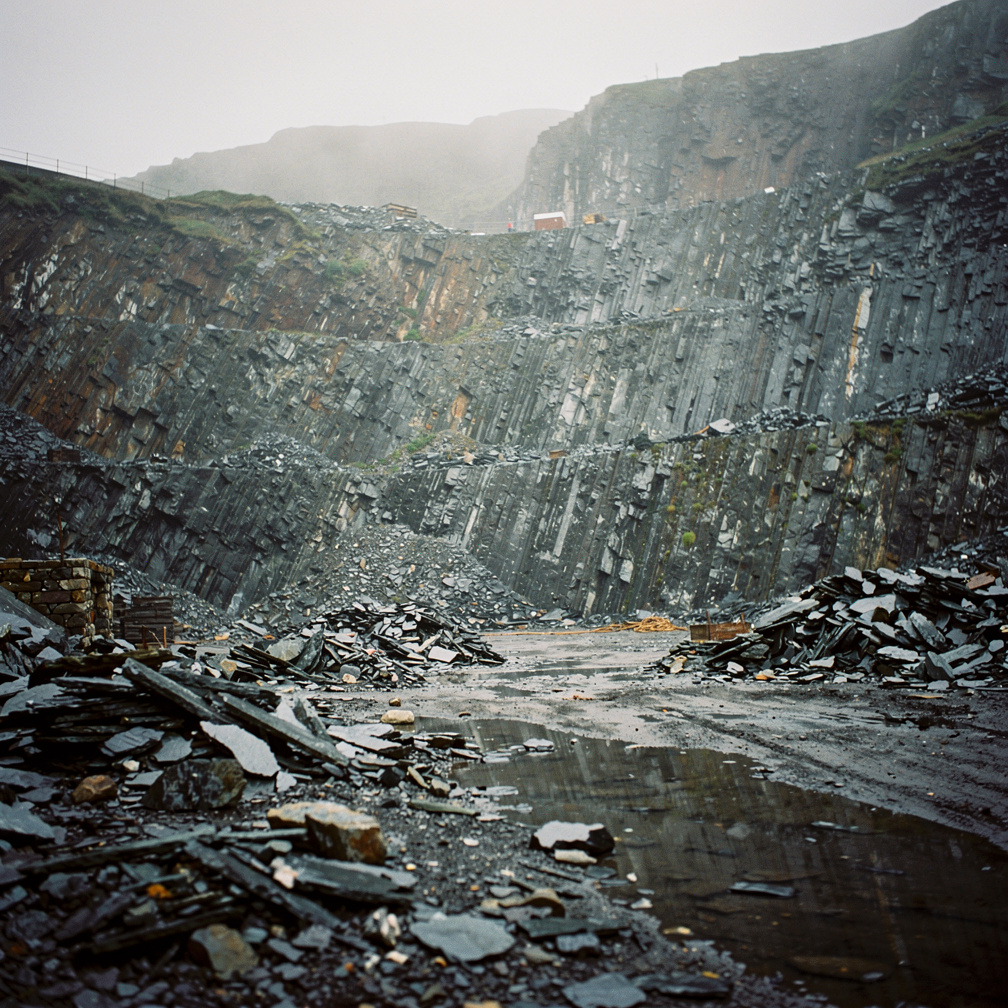
Slate quarrying involves cutting and splitting fine-grained rock from open pits to produce roofing tiles, flooring slabs, wall cladding, and landscaping stone.
Today’s sites employ diamond wire saws, controlled blasting, and hydraulic splitters to maintain block size, strength, and waste at low levels. They then trim, grade, and finish each piece to specific size and flatness limits.
The following sections decompose phases, equipment, and precautions in greater depth.
The Slate Quarrying Process
Slate quarrying traces a straightforward path from finding rock underground to boxing up finished roofing slates and tiles.
-
Locate and evaluate slate deposits using maps, field surveys, and test cuts.
-
Design extraction as open cast (terraced quarries) or underground mines, selecting drilling, blasting and lifting techniques for each level.
-
Quarry sound blocks while protecting workers and managing waste rock.
-
Saw blocks into slabs using diamond tools sized for the intended products.
-
Split slabs by natural cleavage into thin tiles of a fixed thickness.
-
Trim and finish tiles, grade by size and sort, then bundle and ship.
1. Locating Deposits
Geologists begin with regional studies, searching for slate belts formed in ancient, eroded mountain chains where mudstones had been compressed and baked. They read folds, faults, and the broader tectonic history so they can anticipate where unbroken veins are likely to be found rather than sporadic deposits.
North America hosts much working and former slate country in the Great Valley of the Appalachians, but other deposits are found in western states and in European areas that experienced comparable crustal shifts.
Field teams then walk the ground with geological maps, GPS, and hand tools to reconcile the map with what actually crops out. They observe overburden, which has often weathered for millions of years and is now friable, and determine if open-pit extraction terraces, as seen in the Las Arcas slate quarry in San Pedro de Trones, or underground chambers are more appropriate.
This is where they flag neighboring homes, rivers, or transport links that will impact long-term access and hazard. Small test pits and core drilling reveal the color, grain and cleavage of the slate. Teams cut sample blocks, split them, and test whether the rock produces flat slabs without crumble, warp or flake.
They determine the ratio of sound slate to joints and impurities because a deposit that yields 95% waste rock is seldom economical even if the color is ideal.
2. Extracting Blocks
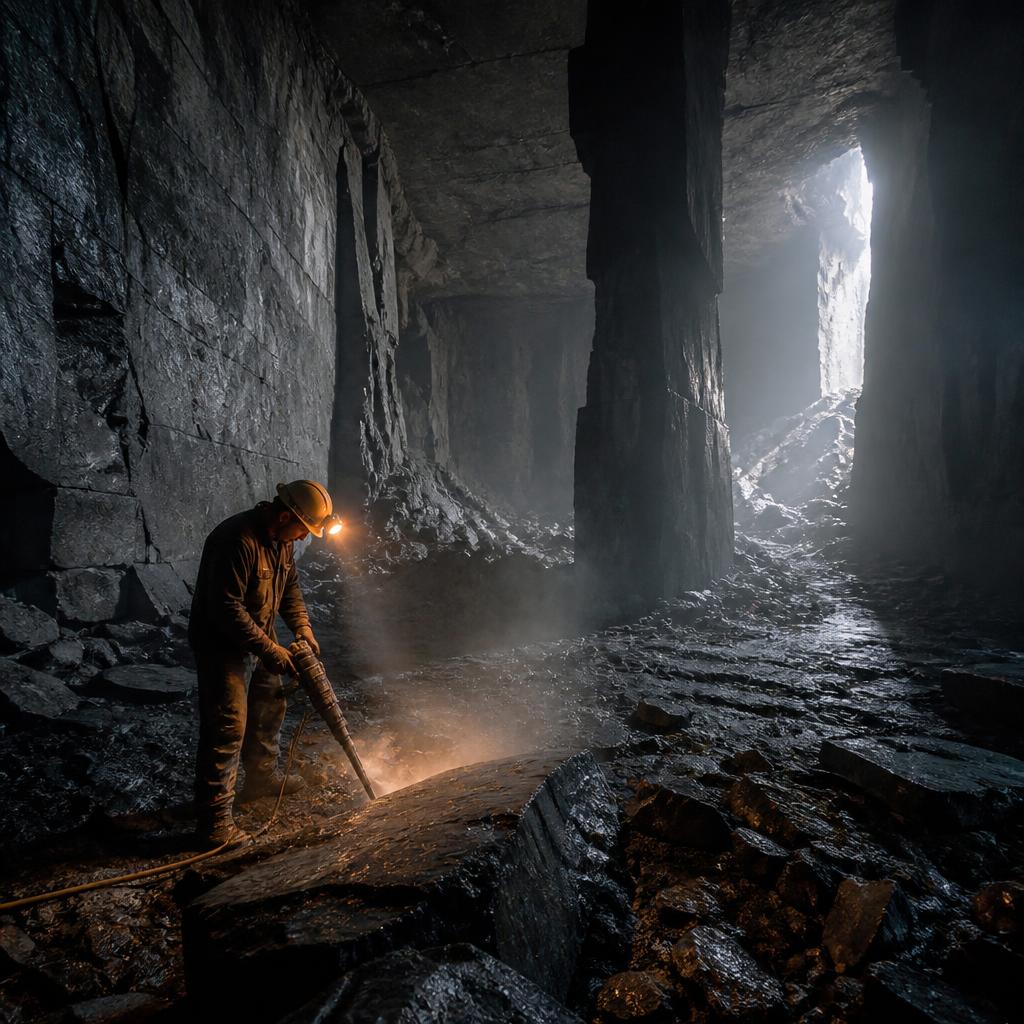
Extraction begins after a quarry plan is established, either as an open cast quarry with benches stepping down the rock or as an underground mine with chambers and pillars. Crews drill shot holes along natural fractures, charge them and fire controlled blasts to liberate large slabs.
In softer areas or adjacent to weak faces, they sometimes forego explosives and deploy mechanical cutters and heavy crowbars to reduce the risk of collapse. Power shovels, front loaders, cranes and steel cable systems transfer the shattered rock and hoist up blocks that show promise.
The secret is to liberate large, uniform blocks instead of tiny, contorted ones since every extra cut becomes additional waste. On each bench, the foreman and geologist monitor rock composition and cleavage direction, then adjust drilling patterns and extraction directions to maximize pull from that level.
Even with careful planning, slate quarrying yields copious amounts of waste rock. In numerous locations, over 90% of all rock extracted is waste. The overburden and off-grade slate are normally piled in tips about the quarry.
No chemicals are involved at any stage, which reduces pollution but creates landscape and stability problems. Because lower levels of older mines can now be flooded and are at risk of collapse, operators monitor groundwater, wall movement, and loose ground prior to dispatching miners or machinery into deeper areas of a site.
3. Sawing Slabs
When the quarry dispatches rough blocks to the works, saw operators align them on beds and slice them into thick slabs. They operate diamond blades, gang saws, and industrial diamond tools sized to the block height and scheduled tile layout, cooling blades with water so that they do not burn the slate.
The saw line frequently saws both harder, dense rock and slightly softer beds from the same quarry. Crews change feed speed, blade type, and cut spacing with each batch. With natural slate, manufacturers attempt to minimize sawing so they don’t slice across the cleavage and weaken it.
They typically saw blocks into a pile of thick slabs, thick enough to hand-split later, rather than sawing them immediately down to roofing thickness by machine, which wastes more stone and causes more corner breakage.
|
Aspect |
Hand Sawing |
Mechanical Sawing |
|---|---|---|
|
Typical scale |
Small workshops, special orders |
Large volumes, standard roofing lines |
|
Tool type |
Hand frames, simple blades |
Diamond circular saws or gang saws |
|
Precision |
Depends on worker skill |
High, repeatable, within tight tolerances |
|
Speed |
Slow, labor‑intensive |
Fast, suited to continuous production |
|
Flexibility |
Easy to adapt to odd shapes |
Best for fixed dimensions and patterns |
4. Splitting Tiles
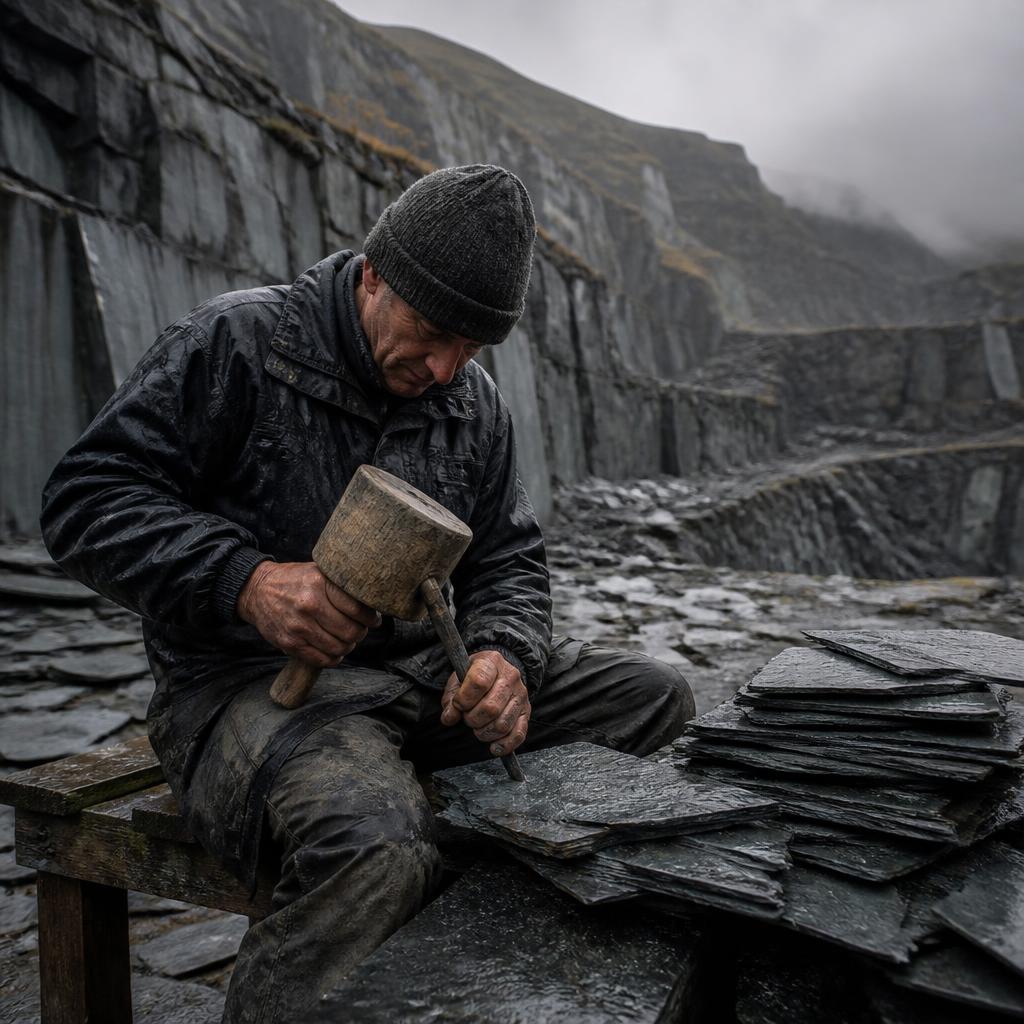
Splitting takes those thick slabs and makes thin tiles by working with slate’s natural cleavage. Experienced workers analyze the grain, then begin a split with a chisel, sledge, or splitting hammer and peel the piece apart in layers.
We try to go along the rock’s own planes so the tile remains flat. It doesn’t taper from one edge to the other. This step still depends on human hands in many areas, even in big plants. Slate splitters estimate how many roof slates they can extract from a single slab and maintain thickness uniformity, frequently targeting a calibration of several millimetres for an entire batch.
When they smooth the surface, some employ gentle abrading and polishing agents, like fine pumice stone, to clean edges or knock off small bumps without thinning the tile excessively. As their stack of tiles grows, workmen keep an eye out for stone that reveals clandestine cracks, soft seams, or rust-out patches of pyrite.
These chunks go either to waste piles or, at some sites, to recycling uses like fill, paths, or crushed aggregate. Since so much rock never becomes a finished product, even small gains in splitting yield make a difference to the economic and environmental impact of the quarry.
5. Trimming Edges
Once split tiles visit the trimmer so they conform to the sizes builders anticipate such as standard roofing sizes, for example, 300 by 200 millimeters or 400 by 250 millimeters, larger flooring tiles, and smaller pieces for cladding or school slates.
Rotary cutters and guillotine-type machines straighten edges and set exact widths and lengths. Smaller or special orders may still be cut by hand with knives or simple bench tools. Trimmers remove rough corners, saw marks, and uneven sides so that each tile will nestle snugly against its neighbors and align with nails or clips on a roof or wall.
Major manufacturers race to standard dimensions so architects can build with predictable coverage and weight. They might maintain a catalogue of special sizes for historic restorations, carved crests, or decorative facades where designers require nonstandard units.
Common product lines such as thin roofing slates, thicker pavers and interior tiles, wide window sills and longer, narrow rainscreen façade panels are cut from the same base rock and trimmed into different formats.
6. Final Finishing
The final stage washes, inspects, and grades the slate prior to its departure from the works. Wash dust off each piece, sometimes polish or brush a little to even out the face, then inspect both sides for chips, warping, hairline cracks, or surface flaws that might grow in service.
Slates that are defective step down into lower grades or are culled out so they never make it to site and fail prematurely. Grading sorts tiles by thickness, size, colour, and surface texture. Darker, more even pieces can be appropriate for exposed roofing and façades, while mottled tones may be acceptable for under-laying or semi-protected zones.
Completed bundles are stacked, strapped on pallets, and marked with batch information, quarry origin, and technical specs such as nominal thickness and anticipated water absorption. They are queued for trucks or containers bound for local yards or export docks.
Quality control runs as a thread through every check. Here it becomes formal, with sample testing and documentation that many markets now request in building codes and green standards.
As no chemicals enter the production line and the principal by-product is inert waste rock, such records help demonstrate where that waste is deposited and how the quarry intends to maintain old pits, tips, and any flooded lower levels in a stable condition into the future.
Global Slate Production
Global slate production now tops 8.6 million metric tons annually across over 35 quarrying regions still active. Trade flows remain largely determined by a handful of dominant centers with deep industrial traditions and characteristic stone varieties.
European Heartlands
Globally Slate Production Europe North Wales, Cornwall and England’s Lake District comprise the traditional heart of the British slate industry. Until the mid-nineteenth century, production in these regions remained small and catered primarily to local markets, constrained by slow transport and hand tools.
With railroads and steam saws, production increased rapidly. By the late 19th century, the wider British slate belt provided around a third of the world’s roofing slates and architectural slabs, shipping throughout cities in Europe and North America.
Penrhyn Quarry in Bethesda and Maenofferen Quarry near Blaenau Ffestiniog still represent Welsh slate. Penrhyn’s purple and heather slates have powerful cleave lines that split clean for roofing. Maenofferen produces darker grey slate, prized for its consistent grain and low water absorption.
Both sites show the main industrial drawback of slate: huge waste piles because more than 90% of rock removed can end up as spoil due to fractures or off-spec color.
On the continent, Spain, France, and Italy constitute a second heartland. Spain accounts for almost 45% of all slate shipped globally, with Galicia alone supplying approximately 90% of Europe’s roofing slate. French deposits in Anjou and Ardennes provide fine-grained, blue-black roofing tiles.
Italian quarries of Liguria and the Aosta Valley produce darker black and greenish slabs for cladding and paving. Throughout Europe, this potent blend of blue, green, and black slate nourishes both restoration and new build. Over 12,000 historic buildings require roof work every ten years, and about 70% of those projects continue to specify natural slate to match original designs.
For example, companies such as Cupa Pizarras (Spain), SSQ, and Welsh Slate (UK) and historic French producers ship primarily to Northern and Western Europe, North America, and parts of Asia. Roofing products comprise approximately 52 percent of global slate usage, with the remainder divided between cladding, flooring, and landscape stone.
For architects and engineers, the consistent export volumes allow them to match local colors—Welsh purple, Galician blue-black, or Ligurian black—on distant projects.
American Veins
Vermont, Pennsylvania, and New York house the principal U.S. Slate belts, each with its own mineral signature and trade ties. Of colored slate, with the well-known Slate Valley on the Vermont/NY border, Granville and the greater NY slate district.
Iron, chlorite and other minerals lend Vermont structural slate its green, purple and mottled tones, appearing in school roofs, lab floors and memorials. Farther south, Buckingham slate from Virginia and dark Pennsylvania slates provide dense, fine-grained black material that lends itself well to steps, countertops and monuments.
These American quarries supply local markets as well as specialized export sectors desiring particular colors or formats, such as thick structural slabs instead of thin roofing tiles. Many operations are based in Appalachian communities where mining, processing, and trucking slate still offer a foundation of employment and local tax revenues, even as overall production remains small relative to Spain or Brazil.
For young planners or builders, this connection between material selection and local economies is a tangible illustration of how spec decisions help forge actual places.
South American Giants
Brazil and Argentina are South America’s top slate producers, with Brazil notably exporting significant quantities of grey, green, and black tile throughout Europe, North America, and Asia. Bambui slate from Minas Gerais is typically fine‑grained, cleaves into broad, flat sheets, and is employed for floor, wall, and exterior paving.
Other Brazilian deposits contribute darker, more homogenous black slate that directly competes with European roofing grades at a lower cost. South American firms have grown rapidly over the last few decades, progressing from exporting blocks to calibrated tiles and packaged roofing sets.
Their climbing market share threatens the older European and North American hubs, particularly in economies that value cost and availability more than matching traditional color. Established centres including Galicia, Wales and the Slate Valley continue to be indispensable for renovation work and expert architecture where precise colour, texture and heritage significance still count.
Quarrying Versus Mining
Slate is sourced from surface slate quarries or underground slate mines. Both intend to access the same rock, but their path, price, and footprint are pretty different.
Quarrying is working from the surface down in open pits with stepped benches. Workers extract the slate in large blocks with diamond wire saws, controlled blasting or hydraulic splitters and then trim it on site into roofing slates, tiles or cladding. This approach is generally preferred initially due to ease of access, short haul roads and the ability of excavators and wheel loaders to relocate large amounts of rock rapidly.
Modern quarrying tools can cut along the natural split planes of the slate, helping to avoid cracks and keep more of each block usable.
Mining involves excavating tunnels and chambers into the slate deposit, occasionally to the extent that virtually no slate is visible at the surface. Underground slate mining requires shafts, ventilation, pumps, power lines and robust roof supports. It is usually more labor-intensive and slower, with smaller machines and tighter restrictions on blasting.
It makes sense where the finest slate lies buried beneath soil and overburden or where surfaces are weathered, folded or too fractured to cleave well. In other cases, the only top-grade, large, flat slabs happen to be at these depths, so mining is the only choice.
Efficiency and cost vary with depth and geology. A shallow slate vein close to the surface normally benefits a quarry since it’s less expensive per tonne to drill, strip, and haul rock upward in the open air than it is to drive long tunnels. A deep or narrow vein may favor mining since removing 60 to 80 meters of waste rock from above it would produce a massive pit and significant slope stability hazard.
Still, slate extraction of any kind produces a lot of waste. More than 90 percent of the rock taken out is often discarded as off-spec blocks, thin pieces, or broken fragments that cannot be split into standard roofing sizes.
Geology determines the decision. If the beds of slate are flat, thick, and near-surface, with pure, even layers, surface quarrying typically offers lower per-unit costs and easier logistics. If the beds dip steeply, run under towns or protected land, or sit below weak overburden that might slide, an underground mine, despite its higher labor and infrastructure costs, may be safer and more acceptable.
In reality, firms frequently begin with a quarry and then go underground as the pit deepens and the stripping ratio becomes uneconomic.
|
Aspect |
Surface Quarrying |
Underground Mining |
|---|---|---|
|
Main access |
Open pit, benches, ramps |
Tunnels, shafts, drifts |
|
Typical depth |
Shallow to moderate |
Moderate to deep |
|
Capital needs |
High for plant, lower for infrastructure |
High for both plant and underground works |
|
Labor intensity |
Lower per tonne |
Higher per tonne |
|
Visible surface change |
High, large open void |
Low; workings can be almost invisible |
|
Waste handling |
Big tips on surface |
Some backfill underground, some surface tips |
Environmental Impact
Surface slate quarries literally remake the face of the landscape. Open pits, haul roads, and large waste tips alter slopes, views, and drainage lines. Where pits slice into hillsides, they can uncover bare rock faces left exposed for decades.
Waste piles can blanket soil that once supported forests or farmland. Water is an additional issue. Rainwater falling on new rock and tailings can wash away silt that could contaminate streams and ponds. If the slate contains iron or sulfide minerals, runoff can stain or reduce water quality.
Operators frequently construct settling ponds, drainage ditches, and silt fences. These slow the water and allow sediment to drop out before it reaches local water bodies. Even local plants and animals sense these fluctuations. Habitat can be lost or fragmented by pits and access roads, and noise and dust can displace certain species.
To mitigate this, some operations establish buffer zones, time blasting to avoid nesting, and plant native species on old waste slopes. In areas with robust regulations, reclamation plans need to be in place prior to quarrying.
WASTE ROCK is at the heart. Because over 90% of quarried rock can become waste, sensible stockpiles, slopes, and drainage are crucial. Some operators now pulverize this waste into aggregates for road bases, drainage layers, or landscaping stones, reducing the demand for new pits elsewhere.
At closure, most quarries regrade steep walls, spread stockpiled topsoil, and replant trees or grass to reintegrate the site into the surrounding landscape. In energy terms, quarrying frequently employs diesel for trucks and loaders and electricity for saws and crushers.
Underground mining adds power load for ventilation fans, pumps, and lighting, therefore the energy consumption per tonne of slate can increase. Mines disrupt less surface area and may be easier to cover against elements, which can reduce some heating and dust control requirements.
Sustainable practice in either now tends to seek to minimize the carbon footprint. This can encompass electric or hybrid equipment in regions with robust power grids, closed-loop water recycling for cutting and washing, and optimizing product yield per block so fewer blocks are quarried.
Other sites experiment with backfilling underground chambers with crushed rejects as a way of minimizing surface tips and stabilizing ground in the long run.
Economic Realities
Whether you profit in slate quarrying or mining depends on how much salable slate can be cut from each cubic meter of rock. Big surface quarries with good geology can shift enormous volumes and profit from scale, which tends to reduce unit cost.
Quarries, as opposed to mines, tend to operate on much larger volumes but may not necessarily access the highest quality slate that commands premium prices, such as thin, even roofing slates or specialist flooring tiles with tight color control.
Cost items accumulate in different ways. In quarries, significant expenses are drilling, controlled blasting, haul truck fuel, loaders and excavators, and crushers and saws. Mines have many of these costs and add tunneling, ground support, ventilation, pumping, hoisting, and more rigorous underground safety systems.
Labor in mines is often more intensive and skilled, and shifts may run around the clock to amortize the fixed infrastructure. Transport is common to both. Heavy slate tiles and roofing slates have to move by truck, rail, or ship, sometimes to export markets many miles away.
As fuel prices fluctuate, the nearness of the quarry or mine to ports and cities has a major impact on competitiveness. Compliance costs matter: permits, environmental monitoring, and restoration obligations raise up-front and life-cycle expenses, especially in high-regulation regions.
Market demand drives all of this. Roofing slate and high-end floor tiles and façade panels occupy niche but steady segments that appreciate the toughness and natural appearance. When construction slows or less expensive alternatives such as concrete tiles gain share, smaller or higher-cost sites might not make it.
Meanwhile, areas with prestigious slate labels are able to establish robust export markets, which supports long-term investment in both quarries and mines. Local and regional economies frequently rely on the slate industry for craftsman-level employment and supplier networks.
One huge quarry can sustain employment in cutting, transport, equipment maintenance, safety and training. Some historic slate regions even develop tourism around old quarries and mines, museums and walking trails, providing an additional revenue source once mining declines.
Worker Safety
Slate workers in quarries encounter a number of fundamental dangers. Rock falls from high faces, unstable waste slopes and misplaced blasts can maim. Drilling, cutting and crushing dust can impact lungs, particularly if there aren’t good water sprays or ventilation.
Heavy mobile equipment, with blind spots and long stopping distances, poses collision and run-over hazards if traffic is not carefully controlled. Safety systems in open pits and underground appear different in practice. Quarries depend on proper face angles, frequent scaling of loose rock, haul road berms, and explicit traffic regulations and walkways.
To mines, roof bolting, shotcrete, mesh, tight control of blast patterns and entry rules for working faces has been added. Since tunnels are enclosed, gas accumulation, bad air and emergency exits must be continually monitored and practiced.
Training is one key control. They must teach workers how to identify unstable ground, handle loads using cranes and forklifts and respond to alarms. Hardhats, safety glasses, steel-toe boots, hearing protection and dust masks or respirators all reduce exposure.
Frequent inspections and audits force operators to maintain systems up to date and address vulnerabilities before incidents happen.
Checklist of recent safety improvements:
- Remote-controlled drills and saws that keep workers away from faces.
- Better dust suppression includes fine water sprays, enclosed conveyors, and local exhaust.
- Sensors for real-time monitoring of slope movement and roof stability.
- GPS and collision‑avoidance systems on trucks and loaders.
- Stricter licensing for machine operators and regular refresher training.
- Emergency response plans with fire, collapse, and blast drills.
- More common usage of health monitoring for lung function and noise exposure.
The Human Element
Slate quarrying is more than a technical process. It’s a web of human beings, decisions and enduring connections between earth, labor and remembrance.
Community Impact
In most slate regions, a quarry grounds the economy. It provides reliable employment in timber cutting, splitting, haulage, equipment repairs, and transport, and it feeds ancillary jobs in housing, nutrition, and community services. A reasonably sized quarry is enough to keep hundreds of people in work if you include staff throughout the supply chain.
It can help stem the flow of outward migration from rural depopulated areas where other industries are limited. Meanwhile, folks living by an active site usually voice obvious issues. Cutting and transport create dust that impacts air quality and prolonged exposure can damage lungs.
Blasting, truck traffic, and noise reconfigure your daily life, even if they’re within the legal limits. Human operations such as quarrying alter drainage patterns and slopes, which can increase the risk of landslides or floods if planning is shabby, so the human element in design and oversight counts as much as the rock itself.
In some countries, planning regulations now require operators to engage the community from the initial survey phase. Public meetings, plain language impact reports and collaborative monitoring groups allow people to witness data on noise, water and dust rather than just assurances.
This type of involvement creates trust and gives local communities a voice in determining how the quarry operates, how the site will be rehabilitated and how advantages such as training or apprenticeships are distributed. Ex-slate belts tend to become regions of heritage and tourism when industrial-scale extraction abates.
Ancient pits are open-air museums, hiking routes or climbing walls, and refurbished factories accommodate street markets and cultural happenings. This shift may preserve local identity connected to slate, but it shifts the primary revenue from uncut stone to narratives, artisanship, and education.
Preserving Heritage
Preserving slate heritage starts with simple, physical things: hand tools, rail carts, winding gear, and early saws that show how workers split and moved stone before modern machines. Without care, these rust away, and future visitors have no idea how much craftsmanship went into estimating a natural cleavage line with one tap.
Museums, like the Slate Valley Museum in the US or Llechwedd in Wales, convert former sites into educational environments. They conduct guided tours in galleries, exhibit original machinery in situ, and utilize transparent panels or digital displays to connect local labor to broader motifs in geology, labor history, and migration.
To younger visitors, these sites demonstrate that earth science isn’t just about remote volcanoes; it’s about people working rock in their own backyard. Workshops and festivals with Welsh-style slate splitting, roof laying, or carving help preserve this old know-how.
Expert ex-quarrymen demonstrate grain-reading, how to hand-split thin tiles, and how to separate waste from good stone. Those moments underscore the fundamentally human desire for camaraderie and common purpose, as families and other visitors observe, inquire, and swap anecdotes.
Oral history projects capture the voices of workers, families and union leaders before they are gone. These interviews frequently expose the ways in which personal anecdotes, danger, ego, and suffering influence quarries’ decision making from safety to migration.
For a lot of academics this human element is crucial for interpreting the landscape itself because benches, spoil heaps and roads only really mean anything if you can connect them back to the people who cut and used them.
Modern Technology
New technology has transformed the way slate is extracted from the earth. It’s still people who steer the ship. Diamond blade saws and wire-cutting systems carve blocks to precise tolerances with less waste. Automated milling lines can trim and shape tiles with great repeatability, but they still depend on people to set parameters, make quality judgments, and shut down when the stone acts in an unexpected way.
Digitally-driven tools now enable smarter quarry planning. Drone surveys map walls and benches in 3D so engineers can monitor slope stability and volume more frequently and at less expense. The geographic information system stores layers of data on rock quality, faults, and water flow, tying geology with the human footprint of haul roads, buildings, and nearby homes.
This is one way geology and the “human element” meet: we read the rock, then decide how to act on it. Environmental monitoring is no longer just an annual report. Some quarries have real-time dust sensors, noise meters, and water probes connected to dashboards.
Staff can see when blasting or cutting edges pushes levels near agreed limits and adjust timing, shielding, or watering. Since mining and quarrying have historically sculpted rivers, hillsides, and even local climates, this type of feedback loop is one effort to scrub harm before it expands.
Some other recent changes target both productivity and safety. Remote-controlled drilling rigs allow miners to work safely at arm’s length from precarious faces. Superior fall-arrest equipment, pain-free road designs, and automatic shutdown reduce incidents.
Such systems don’t eliminate the human element; they relocate it to planning, supervision, and rapid intervention. More than half of the miners viewed this transition as an opportunity to create more resilient quarry communities — a place where a robust safety culture and shared wisdom empower both wellness and sustainable working practices.
Judging Slate Quality
Judging slate quality is about looking beyond the quarry brochure and verifying the stone’s performance in actual application. The principal filters are look, feel, and durability, all tied back to the task you’d like your slate to accomplish.
Color and Texture
Color isn’t just style; it’s mineral mix and weathering behavior. As with roofing slate, they vary from deep black and blue-gray to gentler purple, green, and red. Black slates from places like Spain or Wales tend to provide a consistent, subdued aesthetic that many architects desire on big roofs.
Green and purple slates, found in some regions of the United States and northern Europe, work well on exposed facades or interior flooring where diversity is appreciated. A good quality plate exhibits even color over the entire plate without light striations, iron stains, or sudden patches indicating thin places.
Texture relates directly to how the slate was created. Quality slate has a compact fine-grained body which cleaves clean on its cleavage planes as a result of aligned mica. That split is what allows employees to slice thin roofing shingles and clean floor tiles.
If the grain is coarse or uneven, the slate may cleave in steps and provide uneven thickness. For roofs, that typically results in additional waste and tiles that seat sloppily. For flooring, rough grain can hold dirt and wear prematurely at high ridges.
Mineral content influences both hue and hazard. Quartz imparts hardness and crisp edges. Iron pyrites can produce tiny gold-colored flecks, which some designers appreciate, but they have to be stable. If the pyrites oxidize, they can stain rust brown or create small pits.
If you classify slate by region—for example, blue-gray and fine-grained material from northern Spain or greenish, slightly banded slate from specific parts of the Alps—you begin to notice characteristic color and texture “signatures” that tend to predict performance prior to lab tests.
Durability Tests
For serious projects, quality checks progress from visual to measured performance on finished slates, not only blocks. Typical durability tests are freeze-thaw cycling, where tiles are soaked and frozen repeatedly to make sure they don’t crack or delaminate, flexural strength to measure how much load a tile carries before it snaps, and acid resistance to see how it handles rain with pollution or sea salt.
The highest quality slate exhibits minimal mass loss, retains its strength, and maintains sharp edges following these evaluations. Inspectors get up close and personal with every slice. They look for compact, hairline layering rather than open fissures, steer clear of cracked tiles and keep their eye out for loose pyrites or soft seams that can split open once installed on the roof.
Slate that has rested near the surface as overburden or been blasted poorly is more likely to break, even if it appears pristine initially. Neat extraction, precise splitting and minimal chipping or edge damage while cutting indicate that both the stone and the processing line are controlled.
For roofing in most markets, contractors will now demand certification that traces to transparent standards. In Europe, roofing slate is classified by water absorption, flexural strength, weather resistance, and sulphur content. Elsewhere, similar classifications exist for structural and cladding slate.
Natural slate has centuries of proven life overhead and properly chosen material, dense in sonorous stone, frequently exceeds a century in service. These analyses and certifications are important for long-term cost projections.
Intended Use
Judging slate quality Matching slate to use begins with thickness and exposure. Thin, light tiles are fine on steep roofs that have good under support, whereas thicker slates are appropriate for low-pitch roofs, sites exposed to strong winds and heavy snow areas.
For floors in high-traffic public areas, designers opt for thicker, more resilient slabs that can absorb drops and endure abrasive foot traffic. For chalkboards or memorial tablets, they want very fine, even grain so letters and lines cut clean and remain legible for decades.
Even more, climate and roof design inform roofing decisions. In freeze-thaw zones with numerous wet-cold cycles, select slate with high freeze-thaw and minimal water uptake ratings. On shallow pitches or complex roof shapes, slightly thicker pieces provide more margin of safety against wind-driven rain.
Fixing methods matter too: some slates are drilled for hooks or screws, while others are nailed. The slate must be strong enough around the holes that it doesn’t crack when fixing.
A simple checklist for builders and architects before purchase might include: check color and texture for a uniform look and fine grain, knock on a sample and listen for a clear ring, not a dull thud, check edges for chips, separating plies and exposed cracks, verify quarry test data for freeze-thaw, flexural strength, and acid resistance, test for stable pyrites and low rusting, verify thickness tolerance and size, and inquire how deep in the quarry the blocks originated, steering clear of stuff that is primarily overburden.
When these points come together, you get natural slate that retains form, adheres to the roof or floor, and remains aesthetically steady for decades.
A Sustainable Future?
Sustainability in slate quarrying stands at an intersection of geology, industry, and sustainable building. It impacts how stone is cut from the earth, how much debris remains on site, how energy and water are used, and how structures behave for a century or more. Sustainability isn’t just about what looks green today; it’s about what lasts.
Advocate for environmentally friendly quarrying practices and reduced waste in slate production
Cleaner quarrying begins in the way slate is mapped and pulled from the earth. Fine-tuned geological surveys and digital 3D models eliminate the guesswork, so operators open fewer faces and disrupt less land. Controlled blasting, wire saws and diamond blades help keep blocks intact, which translates into more usable slate per cubic metre of rock.
When a quarry applies this type of planning, it cuts overburden and haul distances and reduces rejected blocks. For local communities, that frequently translates into reduced dust, noise and truck traffic in the vicinity of homes and schools. ISO 14001 certification drives sites to measure their impacts, target waste and emissions and review them on schedule instead of one-time add-on ‘green’ steps.
Support research into alternative uses for waste rock and unusable slate
Even the most efficient slate plants leave behind offcuts, chips and broken tiles. Rather than abandon those to spoil heaps, research is transforming them to aggregate for road bases, drainage layers and concrete mixes. Powdered slate can be incorporated in ceramic tiles, cement substitutes, or landscaping goods.
In certain areas, fine slate waste already edges garden walkways, packs gabion baskets, or serves as a robust sub-base beneath rail lines. All of these reuses reduce the demand for quarrying new gravel elsewhere and extend the environmental benefit beyond the slate industry itself.
Encourage the adoption of renewable energy and water recycling in slate factories and quarries
Sawing and finishing slate consume significant amounts of electricity and process water. Cutting sheds mounted with solar panels, on-site wind in exposed valleys, and grid contracts from renewables all reduce the embodied carbon of every square meter of tile. Closed-loop water systems trap the slurry off saws, allow the particles to settle, and pump the water back into use.
This minimizes fresh water draw and polluted run-off into rivers. For younger professionals who will work in this sector for decades, these systems establish a new baseline for what “normal” heavy industry looks like.
Promote the role of natural slate as a sustainable, long-lasting building material for future generations
Natural slate has among the lowest embodied carbon of any construction material, largely due to its minimal processing requirements and lack of energy‑intensive firing. Unlike asphalt or synthetic roofing, natural slate must be minimally processed, lasts over a hundred years, and can be recycled.
A correctly installed slate roof endures 100 to 150 years and natural slate can last more than three times longer than alternative roofing materials, which compounds its advantage over time. A roof that lasts only a few years may be less expensive in year one, but it needs to be replaced two or three times, along with all the additional transportation, labor, and waste.
Recycled slate, from careful demolition or surplus stock, can deliver a significant carbon saving against alternatives because it avoids both new manufacture and landfill. With many slate quarries now protected under UNESCO status, this adds yet another level of oversight on how extraction, landscape care, and heritage protection all fit together.
In reality, long-lasting materials such as slate assist city planners, architects, and owners align climate objectives with structures that don’t have to be repaired every generation.
Conclusion
Slate quarrying reveals a close connection between stone, craft and patient labor. Every cut, every drill line, every split is based on clean decision, not assumption. From hand tools in a tiny valley to big saw rigs in Spain or China, the fundamental steps remain. Workers read grain, spot flaws and sort each slab by sight and hand.
The field today stands at a turn. Companies test cleaner fuel, plot shorter haul routes, and attempt to reduce waste on location. Others monitor water consumption or dust dispersal in real time. As next steps, watch out for neighborhood quarry regulations, inquire about source sites when you talk to suppliers, and benchmark slate against other roof or floor options on real projects.
Frequently Asked Questions
What is slate quarrying?
About: slate quarrying Workers mined slate. This involves drilling, blasting or cutting and carefully splitting along the grain.
How is slate different from other quarried stones?
Slate, a fine-grained metamorphic rock, cleaves into thin, flat sheets. This makes it perfect for roofing and cladding. Unlike granite or marble, slate is not polished but is typically employed with a natural, textured surface that offers grip and weather resistance.
Where is slate most commonly quarried worldwide?
Other significant producers of slate are Spain, China, Brazil, India, and other European countries like Wales and Italy. They have big premium slate deposits and a long tradition of both quarrying and working the stone.
How do quarry workers judge slate quality?
Workers check for color consistency, grain, density, and the split-ability of the slate. Good slate has little impurities or cracks, splits evenly into thin layers, and has stable color. These characteristics contribute to long service life and strong performance in roofing or flooring.
What is the difference between quarrying and mining slate?
Quarrying slate is typically surface mining of slate from open pits or terraced faces. Mining is mostly underground. Slate is mostly quarried, not mined, as it frequently occurs in extensive, close to the surface beds that may be worked from the surface.
Is slate quarrying environmentally sustainable?
Slate can be fairly sustainable, as quarrying companies today take care to handle waste, protect local water supplies, land restoration, and energy conservation. Slate is hardwearing and reduces the need for replacements. Sustainability is a matter of local regulations, quarry practices, and transport distances.
What are the main risks for people working in slate quarries?
Principal hazards are rock falls, dust, noise, vibration and heavy machinery accidents. Today’s quarries mitigate these dangers with employee safety training, protective gear, dust suppression, and rigid protocols. Good safety management is a must to save workers’ health and lives.