
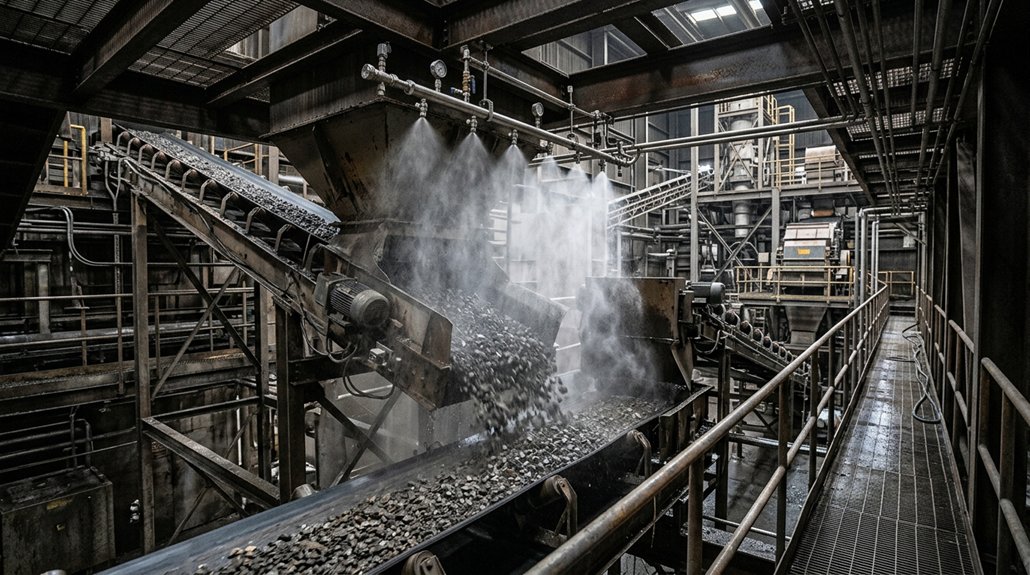
The finest dust particles can pose the greatest risk while remaining nearly invisible around a processing plant. You need to select a dust suppression system based on dust sources, particle size, material moisture, and process conditions—not simply equipment cost. Water sprays, dry fog, foam, and enclosed dust collectors each suit different applications, with ventilation and maintenance affecting performance. Start by matching control technology to the emission point, because the wrong choice can increase water use, downtime, and compliance problems.
Key Takeaways
- Assess dust sources, particle size, toxicity, combustibility, and worker exposure across crushing, screening, conveying, transfer, and loading areas.
- Match technology to material moisture, particle behavior, throughput, airflow, temperature, and product-quality requirements.
- Choose water sprays for broad wetting, fogging for fine airborne dust, or foam and additives for enhanced capture with lower water use.
- Integrate suppression with ventilation, strategically positioned collection points, negative pressure, sensors, controls, and filtration equipment.
- Evaluate water demand, wastewater compliance, freezing, maintenance, reliability, operating costs, and environmental impacts before selecting a system.
Identify Dust Sources, Particle Size, and Exposure Risks
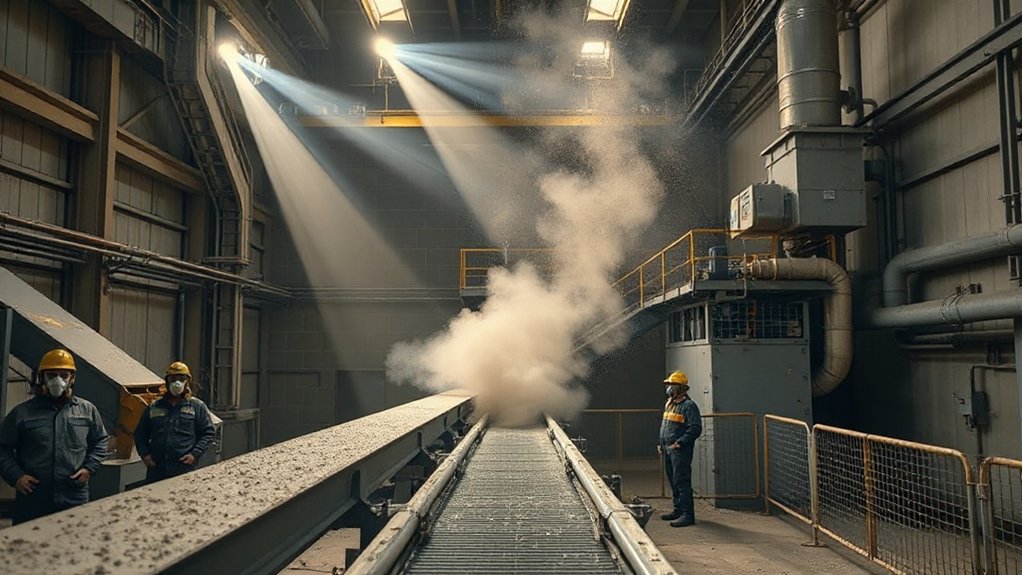
Before selecting a dust suppression system, identify where dust originates, how particles become airborne, and who may be exposed.
Map airborne contaminant sources across receiving, conveying, crushing, screening, transfer, loading, and cleanup areas.
Observe release points during normal operation, startup, shutdown, maintenance, and upset conditions.
Then perform dust particle classification by measuring aerodynamic size, concentration, and composition.
Coarse particles may settle quickly, while respirable fractions can remain suspended and penetrate deep into the lungs.
Review safety data and process samples for combustible, toxic, corrosive, or abrasive constituents.
Assess exposure for operators, contractors, maintenance personnel, and nearby communities, considering task duration, proximity, ventilation, and access.
Use personal and area sampling to establish baseline conditions, prioritize monitoring, and define performance requirements for subsequent system selection and validation.
Match Dust Control to Material and Process Conditions
You’ll need to match your dust suppression system to the material’s moisture level and particle size distribution.
Consider how these properties affect dust release, conveyance, and capture efficiency.
Then adjust the system for process operating conditions such as throughput, temperature, airflow, and equipment layout.
Material Moisture Levels
Material moisture levels directly affect how easily particles become airborne and which dust suppression method will work. When your feed is dry, fine dust can escape during transfer, crushing, screening, and loading. You may need water sprays, foam, or atomized mist to bind particles at their release points.
However, excessive water can create mud, block screens, overload conveyors, or reduce product quality. Evaluate material moisture across the full process, because feed conditions can change between storage and handling. Adjust spray volume, pressure, and timing to match production rates rather than applying constant flow.
In enclosed areas, controlled humidification can support dust settling without saturating equipment. Monitor moisture with routine sampling and verify suppression performance through visible emissions, housekeeping requirements, and product specifications.
Your chosen system must control dust while preserving reliable operation.
Particle Size Distribution
Moisture control works best when you also account for particle size distribution, because coarse material and fine dust respond differently to suppression. Coarse particles generally require targeted wetting to prevent release during transfer, crushing, or screening.
Fine particles demand finer droplets, foam, or atomized treatment that captures dust without excessive water use. You should measure the material’s size range and identify the fraction most likely to become airborne. Excessive moisture can cause Particle agglomeration, block screens, increase handling loads, or affect product quality.
Insufficient coverage leaves respirable fines available for airborne contamination and worker exposure. Select nozzles, spray patterns, and additives according to particle behavior, not simply total tonnage. A properly matched system improves capture efficiency while preserving flowability and minimizing downstream cleanup requirements.
Verify coverage across every dust-generating material stream.
Process Operating Conditions
Because dust release changes with operating conditions, you should match suppression to the process rather than rely on a fixed spray rate. Evaluate feed rate, material moisture, temperature, conveyor speed, transfer height, and airflow before selecting nozzles or enclosures.
Dry, fine particles may require controlled misting, while wet or sticky material can demand reduced water application to prevent buildup, plugging, or product degradation. Adjust spray pressure and flow as production changes, and interlock suppression with feeders, crushers, and conveyors so protection remains active during operation.
Use ventilation strategically: Air filtration can capture residual airborne dust, but excessive airflow may increase entrainment and carryover.
Complete a Hazard assessment to identify combustible dust, worker exposure, corrosion, and visibility risks. Verify performance through dust monitoring, equipment inspections, and periodic process reviews.
Compare Water Spray and Fogging Systems
Water spray and fogging systems both control airborne dust, but they work best in different conditions. Choose water spray when you need broad coverage, rapid wetting, and straightforward control at transfer points, crushers, or stockpiles.
Larger droplets suppress dust by capturing particles and settling them, but they can increase moisture, runoff, and material handling concerns. Select fogging when you need finer droplets and targeted airborne-particle capture with lower water consumption.
Fogging performs best in enclosed or semi-enclosed areas where airflow, nozzle placement, and droplet evaporation remain manageable. You’ll need to match pressure, flow rate, water quality, and particle size to each application.
Effective dust mitigation also depends on sensors, controls, and Technology integration with conveyors and ventilation. Verify visibility, freezing risk, maintenance access, and housekeeping requirements before committing to either system.
Evaluate Dry Fog and Foam Systems
You’ll assess dry fog performance by checking droplet size, coverage, airflow interaction, and water consumption.
You’ll also examine foam system advantages, including stronger surface adhesion, extended suppression, and reduced airborne dust.
Select the system that matches your material, operating conditions, and control objectives.
Dry Fog Performance
Dry fog systems suppress dust by atomizing water into fine droplets that capture airborne particles without particularly wetting the material or work area. You can use this approach where moisture-sensitive products, housekeeping limits, or conveyor visibility matter.
Performance depends on matching droplet size to dust particle behavior: droplets must interact with respirable and larger particles while remaining suspended long enough for effective contact. Positioning nozzles near transfer points, crushers, screens, and discharge areas helps intercept airborne contaminants at their source.
You’ll need adequate air and water pressure, balanced coverage, and regular nozzle inspection to maintain consistent output. Enclosures and airflow management further improve capture efficiency.
Monitor dust concentrations, visibility, and product moisture after installation so you can adjust operating parameters and verify that the system meets plant requirements.
Foam System Advantages
Foam systems can outperform dry fog when you need to suppress heavy dust at bulk-material transfer points, stockpiles, crushers, or loading areas where wind and airflow quickly disperse fine droplets. Foam blankets particles, increases moisture contact, and resists displacement, giving you more reliable control during high-throughput operations.
Evaluate Foam stability carefully: a persistent blanket can reduce water consumption and limit reapplication, while excessive collapse can increase runoff and maintenance. You’ll also gain broader coverage on irregular material surfaces than dry fog typically provides.
However, select surfactants and proportioning equipment for your dust chemistry, process temperature, and safety requirements. Consider Environmental impact before approval; choose biodegradable additives, control drainage, and verify that treatment won’t affect product quality or wastewater compliance.
Use foam where sustained suppression justifies added equipment and operating complexity.
Compare Dust Collection for Enclosed Plant Processes
When a process is enclosed, you’ll typically compare dust collection systems by capture efficiency, airflow control, maintenance demands, and compatibility with the material being handled.
Start by mapping emission points around crushers, screens, transfer chutes, and mixers. A properly sized central collector can maintain negative pressure and prevent fugitive dust from escaping access doors or joints.
Compare cartridge, baghouse, and cyclone configurations according to particle size, loading, temperature, and required outlet concentration. Innovative filtration media can improve separation performance without excessive pressure drop.
Evaluate duct routing, hood design, fan capacity, and automated damper control together; each affects capture reliability and energy demand.
Ventilation enhancements, such as make-up air balancing and strategic pickup points, can stabilize airflow throughout the enclosed process and protect nearby equipment.
Review Water Use, Maintenance, and Compliance
Review water use, maintenance requirements, and compliance together before selecting a suppression system. Quantify consumption during normal production, startup, and washdown, then verify that your supply and drainage infrastructure can handle peak demand.
Assess whether recovered or recycled water is suitable, especially where contaminants could affect product quality or equipment reliability.
Review Chemical additives carefully; confirm storage, dosing, worker-protection, and discharge requirements before use.
Establish inspection intervals for pumps, nozzles, filters, valves, and controls, and keep critical spares available to prevent unplanned downtime.
Include freezing protection, corrosion control, and access for safe cleaning.
Check permits, wastewater limits, dust-exposure obligations, and site-specific environmental impact assessments with your compliance team.
Document monitoring methods, alarm settings, and maintenance records so you can demonstrate control during audits and regulatory inspections.
Build a Shortlist and Choose Your System
Once you’ve defined water capacity, maintenance needs, and compliance limits, build a shortlist by comparing each system’s dust-capture performance, operating cost, reliability, and fit with your material and process.
Evaluate fogging, atomizing, dry-mist, foam, and enclosed-transfer options against your critical emission points. Confirm droplet size, coverage, control response, and compatibility with conveyors, crushers, screens, and stockpiles.
Request supplier data from comparable installations, including uptime, water consumption, spares, and service intervals.
Calculate total ownership cost rather than equipment price alone; energy, labor, water treatment, and downtime determine cost efficiency.
Assess Environmental impact by reviewing runoff, wastewater, additives, and worker exposure.
Select the system that meets your compliance margin without overwatering products or creating maintenance problems.
Document selection criteria, test results, and acceptance targets before procurement, installation, and commissioning begin.
Frequently Asked Questions
How Much Does a Dust Suppression System Typically Cost to Install?
You’ll typically spend $10,000–$100,000 installing a dust suppression system, depending on plant size, technology, automation, and site conditions. For accurate cost estimation and budget planning, obtain vendor quotations, installation requirements, and maintenance projections.
Can Dust Suppression Systems Be Retrofitted Into Existing Processing Plants?
Yes, you can retrofit dust suppression systems into existing processing plants—even transforming dusty operations overnight. You’ll integrate sprays, misting, or foam at emission points, while evaluating Environmental impact, Regulatory compliance, water availability, access, and production continuity.
What Training Do Operators Need to Safely Use Dust Suppression Equipment?
You need Operator safety training programs covering equipment operation, chemical handling, pressure hazards, PPE, emergency shutdowns, inspections, and maintenance. You’ll also practice spill response, verify competence, and refresh training whenever procedures or equipment change.
How Long Does Installation Usually Take for a Complete Dust Suppression System?
You’ll typically complete installation in two to eight weeks, depending on plant size, equipment availability, site preparation, and integration requirements. Plan commissioning, Dust control verification, operator training, and Equipment maintenance handover before startup.
Which Suppliers Provide Reliable After-Sales Service and Replacement Parts?
You’ll find reliable After sales support and replacement parts from OEMs such as Donaldson, Nederman, DustBoss, and Duztech. Confirm regional technicians, stocked components, response times, warranties, and commissioning assistance before selecting your supplier.
Conclusion
Choosing the right dust suppression system starts with a clear view of sources, particle sizes, and exposure risks. Match sprays, fogging, dry fog, foam, or dust collectors to your material, moisture, airflow, and process conditions. Then compare water demand, maintenance, monitoring, and compliance costs. By building a balanced shortlist and testing performance, you’ll select a practical, powerful solution that protects personnel, improves plant reliability, and keeps fugitive emissions controlled without compromising production.