
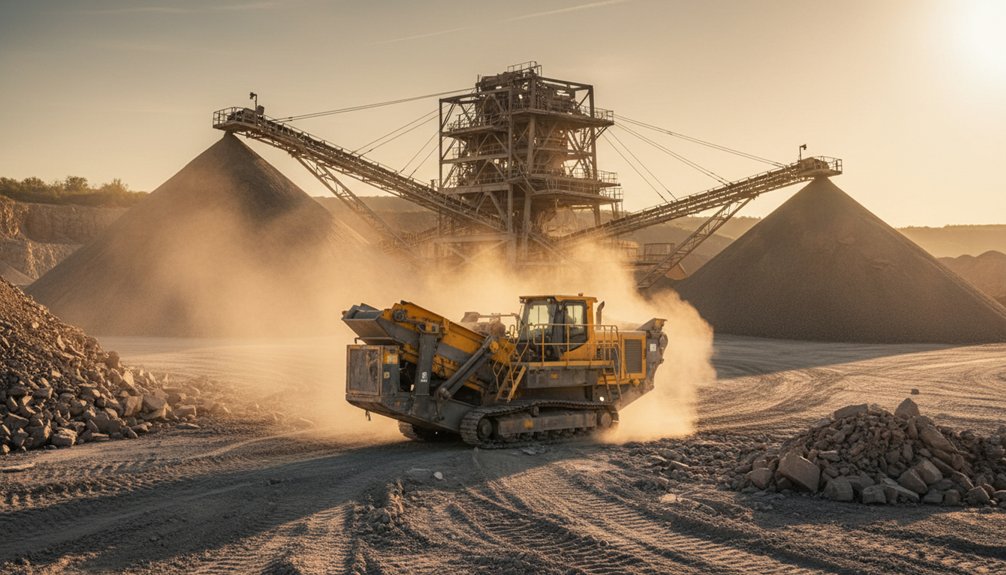
Choosing between mobile and fixed crushing plants directly affects your quarry’s cash flow, capacity, and operating risk. A mobile plant gives you lower upfront costs, faster deployment, and shorter haul distances, while a fixed plant can deliver greater throughput and lower unit costs over a stable, long-term operation. To protect your margin, you’ll need to weigh material characteristics, relocation needs, maintenance, labor, and downtime—because the cheaper option at purchase may not be the most profitable over its service life.
Key Takeaways
- Choose mobile plants for changing extraction faces, short-term contracts, phased development, and reduced haulage, civil works, and relocation costs.
- Choose fixed plants for stable, long-term operations requiring consistently high throughput, automation, centralized control, and lower costs at high utilization.
- Compare total cost of ownership, including purchase, installation, fuel, labor, maintenance, wear parts, downtime, expansion, resale value, and cost per ton.
- Evaluate site and material conditions, including hardness, moisture, gradation, space, ground capacity, access, utilities, and environmental constraints.
- Protect profitability through reliability, prioritizing maintenance access, spare-parts availability, remote monitoring, safety systems, environmental compliance, and minimized production interruptions.
Compare Mobile and Fixed Crushing Plants
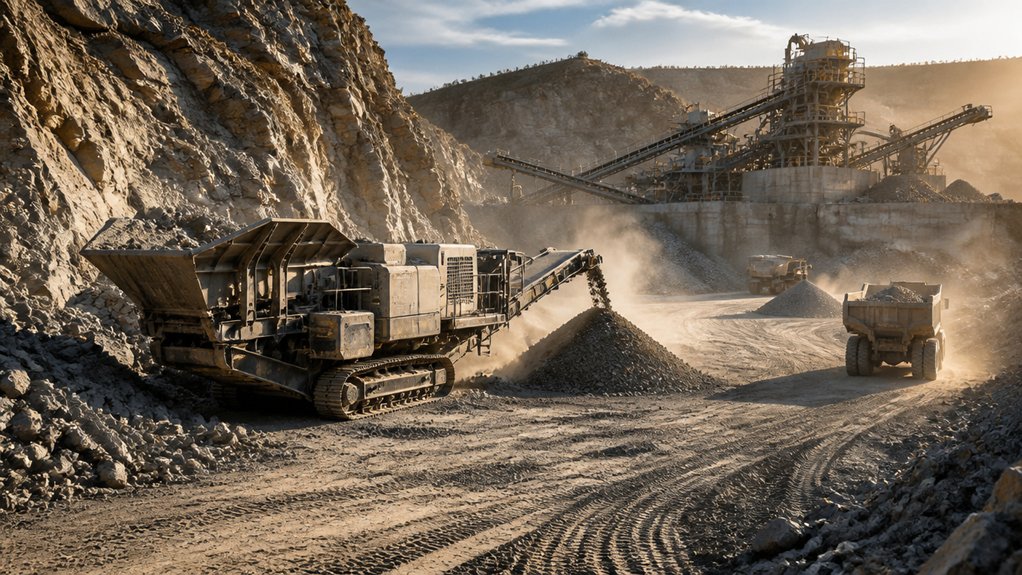
Mobile crushing plants are designed for rapid deployment and relocation, while fixed plants provide higher structural stability and consistent, high-capacity production at a permanent site.
Choose mobile equipment when you need to follow a changing extraction face, reduce haul distances, or limit civil construction. You’ll typically gain faster commissioning and simpler relocation, but you must manage transport logistics, ground preparation, and equipment stability at each position.
Fixed plants suit long-life quarries with established infrastructure, permanent power, and predictable material flow. Their foundations, conveyors, and service access support orderly operation, though installation requires greater capital and planning.
Evaluate each option’s environmental impact, including traffic, dust, noise, land disturbance, and rehabilitation obligations.
Apply safety considerations to access routes, setup procedures, guarding, maintenance isolation, and emergency response.
Compare Capacity and Process Efficiency
You’ll compare production capacity by evaluating rated output, operating hours, and material demand.
You’ll also evaluate process-flow efficiency through transfer distances, bottlenecks, and screening or crushing stages.
Finally, you’ll assess throughput flexibility to determine how each plant adapts to changing feed rates and site conditions.
Production Capacity
When production demand rises, fixed plants typically deliver greater capacity and process efficiency because their larger equipment, automated systems, and optimized material flow support continuous high-volume operation. You can sustain higher throughput with larger crushers, screens, conveyors, and stockpiles, reducing production interruptions caused by frequent relocation.
That capacity advantage matters when your quarry serves long-term contracts or tight delivery schedules. However, you’ll need sufficient reserves, power infrastructure, and capital to justify the installation.
Mobile plants can provide lower initial commitment and scalable output, but their capacity may decline when relocation, site access, or transport constraints limit operating time.
Evaluate your target tonnes per hour, peak demand, operating hours, and expansion requirements. Also consider environmental impact and regulatory compliance, since higher capacity may increase noise, dust, energy use, and permitting obligations.
Process Flow Efficiency
Efficient process flow depends on how consistently each stage—from feeding and crushing to screening, conveying, and stockpiling—maintains the plant’s target rate. When you compare mobile and fixed plants, evaluate more than rated capacity. Track feed uniformity, crusher utilization, screen recirculation, conveyor loading, and transfer-point losses.
A fixed plant typically delivers steadier flow because its anchored layout supports optimized equipment spacing, robust conveyors, and centralized control. A mobile plant can achieve efficient flow when you minimize haul distances and coordinate equipment settings, but frequent repositioning may introduce interruptions and alignment challenges.
Measure tons per hour at the final product, not only at the primary crusher. You should also assess energy use, dust, noise, and fuel consumption as part of the environmental impact.
Finally, include safety considerations around access, guarding, traffic, and maintenance.
Throughput Flexibility
Throughput flexibility measures how well a plant maintains production as feed rates, material characteristics, and operating conditions change. A mobile plant lets you reposition crushing and screening stages near the active face, shortening haul distances and adapting material handling to changing benches. That flexibility can sustain usable capacity when quarry conditions shift, but limited surge storage, transport constraints, and smaller equipment may reduce peak throughput.
A fixed plant typically delivers higher, steadier capacity through larger crushers, extensive stockpiles, automated controls, and optimized process flow. You’ll gain efficiency when feed remains consistent, yet expansion or feed changes may require costly modifications.
Compare hourly throughput under realistic moisture, gradation, and downtime assumptions—not nameplate ratings. Also evaluate fuel use, haulage, dust control, and environmental impact. Your best choice balances recoverable capacity, process stability, relocation needs, and lifecycle cost.
Compare Total Costs of Both Plant Types
Comparing total costs requires more than looking at the plant’s purchase price. Your cost analysis should include installation, commissioning, engineering, foundations, electrical systems, and initial spares.
Fixed plants often demand higher upfront infrastructure spending, while mobile plants may reduce installation costs but carry greater purchase or leasing rates.
Next, calculate operating expenses per ton. Include fuel or power consumption, labor, lubrication, wear parts, maintenance, repairs, insurance, and production downtime.
Mobile equipment can simplify servicing, whereas fixed systems may deliver lower energy costs at sustained, high utilization.
Add financing charges, depreciation, taxes, and expected resale value to your model.
Your budget considerations should also cover replacement cycles and contingency reserves.
Compare five- to ten-year ownership costs using realistic throughput assumptions, then test fuel prices, utilization, and maintenance inflation.
The lowest purchase price rarely delivers the lowest cost per saleable ton.
Check Material, Site, and Relocation Needs
Cost projections only hold if the plant suits the feed material and site conditions. Start by testing hardness, abrasiveness, moisture, and particle size. Match those characteristics to the crusher, screen, and conveying arrangement you’ll use; an unsuitable configuration can reduce product quality and increase energy demand.
Then assess bench geometry, ground bearing capacity, access routes, elevation changes, and available space. A fixed plant may fit a long-life deposit with stable infrastructure, while a mobile unit can follow changing faces and shorten haul distances.
Quantify each option’s environmental impact, including dust, noise, traffic, and land disturbance. Confirm regulatory compliance for permits, emissions, water management, and relocations before selecting equipment.
If your reserve plan includes multiple pits or phased extraction, prioritize transportability, setup footprint, and the time required to reposition the plant safely.
Compare Maintenance, Labor, and Downtime
You’ll compare maintenance costs by evaluating service frequency, parts access, and repair complexity for each plant type.
You’ll also assess labor requirements, including operator skill, staffing levels, and setup time.
Finally, you’ll measure how maintenance and labor affect downtime, production continuity, and total operating cost.
Maintenance Cost Comparison
When evaluating mobile and fixed plants, you’ll need to compare more than scheduled maintenance expenses: labor requirements, access to service points, parts logistics, and downtime all affect total operating cost.
Mobile plants typically require frequent inspection of tracks, conveyors, hydraulic systems, and relocatable connections. Their compact layouts can shorten access routes, while vibration and transport may increase component wear.
Fixed plants often provide robust platforms and centralized service access, but extensive structures, foundations, and buried utilities can raise repair complexity and parts-handling costs.
Compare each option using annual maintenance hours, replacement-part consumption, lubrication schedules, and planned outages.
Innovative technology, such as remote condition monitoring, can identify faults before failures and reduce unnecessary servicing.
Also evaluate environmental impact: spills, dust controls, and energy use can create compliance-related maintenance expenses.
Don’t rely on purchase price alone.
Labor And Downtime Impacts
Labor and downtime impacts often determine whether a mobile or fixed plant delivers the lower total operating cost. With a mobile plant, you can relocate crushing and screening closer to the extraction face, reducing haulage labor and truck-related delays. However, you’ll need operators who can manage frequent moves, setup checks, and changing feed conditions.
A fixed plant typically simplifies daily operation and supports automation, but you may require longer material-handling systems and more labor to maintain conveyors and transfer points.
Compare downtime exposure, not just headcount. Mobile equipment can restart production quickly after relocation, while fixed systems may suffer extended outages when a major component fails. Evaluate spare-parts access, technician response, and planned maintenance windows.
Include safety considerations and environmental impact: fewer haul trips can reduce traffic risks, fuel use, dust, and emissions.
Match Plant Type to Your Production Goals
Choosing between a mobile and fixed plant starts with your production goals, site conditions, and expected project duration.
If you’ll move between pits, serve short-term contracts, or adjust output frequently, a mobile plant can match changing feed locations and capacity requirements. Its compact layout supports phased development, but you’ll need to plan transport, setup, and utility connections carefully.
Choose a fixed plant when you’ll process consistent volumes at one established site for years. Its engineered foundations, larger storage capacity, and integrated circuits can support stable gradation and high throughput.
Evaluate feed characteristics, required product sizes, expansion plans, and available space before deciding.
Include environmental impact in your assessment, especially dust, noise, traffic, and land disturbance.
Address safety considerations through access design, guarding, emergency systems, and traffic separation.
Choose the Setup That Protects Profit
How will each setup affect your margins after installation? A fixed plant usually delivers lower unit costs at high, stable volumes because you optimize conveyors, power distribution, and automation. However, its civil works, permitting, and relocation limits create substantial capital exposure.
Choose mobile equipment when your quarry changes benches, faces variable haul distances, or needs phased investment. You’ll reduce initial infrastructure spending, but account for fuel, transport, setup time, and potentially higher maintenance per ton.
Compare total cost per saleable ton, not purchase price alone. Include Environmental impact: mobile units can reduce haulage and disturbance, while fixed systems may improve energy efficiency.
Evaluate safety considerations, including traffic separation, guarding, access, and maintenance isolation. Model downtime, resale value, expansion costs, and realistic utilization before committing.
The most profitable setup matches your production schedule and site life.
Frequently Asked Questions
What Permits Are Required Before Installing a Mobile or Fixed Crushing Plant?
You’ll typically need Permit requirements covering air emissions, stormwater, noise, zoning, and environmental impacts, plus installation approvals for foundations, electrical systems, fire protection, and site access; confirm conditions with local regulators first.
How Do Environmental Regulations Affect Mobile and Fixed Plant Selection?
Environmental impact and Regulatory compliance shape your plant choice. You’ll favor mobile equipment when permits demand flexibility and reduced disturbance; fixed plants may suit established sites with approved infrastructure, controls, monitoring, and predictable emissions management requirements.
Can Mobile and Fixed Plants Process Recycled or Contaminated Materials?
You can process recycled and contaminated materials—turning mountains of waste into usable aggregate. Evaluate material contamination, then select sorting, washing, magnets, and crushing stages. Compare recycling capabilities, capacity, maintenance, and permits before choosing mobile or fixed equipment.
What Safety Features Should Operators Expect From Each Plant Type?
You should expect Safety protocols and hazard prevention on both: mobile plants need guards, emergency stops, stabilizers, dust suppression, and clear access; fixed plants add dedicated platforms, interlocks, isolation systems, and controlled maintenance zones.
How Do Resale Values Compare Between Mobile and Fixed Crushing Equipment?
Mobile crushers are pickup trucks; fixed plants are buildings. You’ll usually find stronger Resale value in mobile units because Equipment depreciation stays lower, reflecting portability, standardized components, and broader buyer demand, while fixed installations resell locally.
Conclusion
Protecting your quarry’s bottom line starts with matching the plant to your operating reality. Choose mobile crushing plants when changing faces, phased development, and shorter haul routes matter most; they’ll keep your investment nimble. Choose fixed plants when stable reserves, high throughput, and process efficiency can repay greater capital costs over time. Compare capacity, lifecycle expense, maintenance, labor, downtime, and relocation needs carefully. When your plant fits your production goals, every ton carries more profit.