
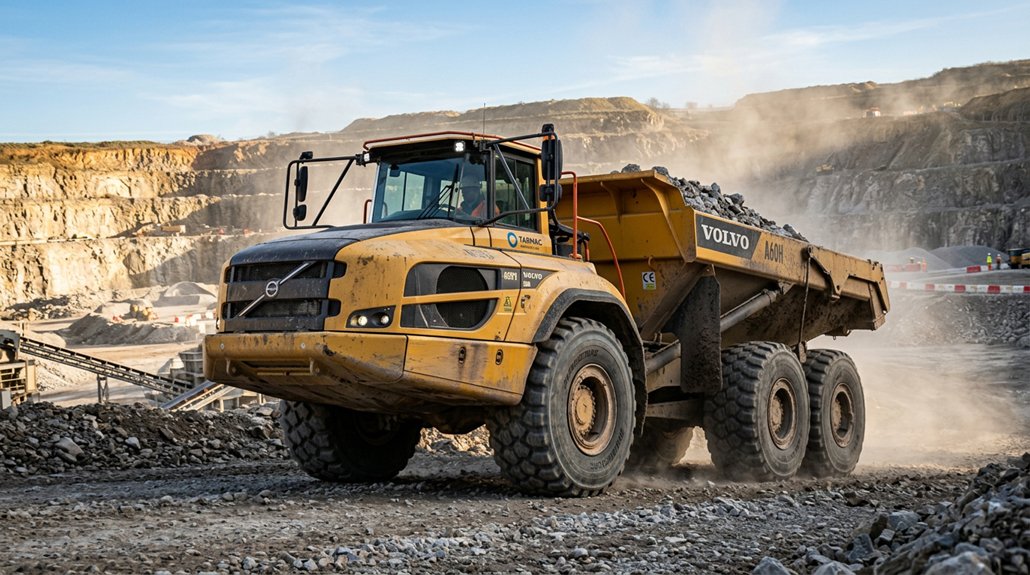
When you assess the largest dump trucks operating in the UK, you’re looking at far more than payload figures. You’ll find rigid and articulated machines engineered for demanding quarry faces, major earthworks and continuous haul cycles. Caterpillar, Komatsu and Volvo models combine high-torque powertrains, reinforced frames and advanced monitoring systems to move material efficiently. But which trucks genuinely lead the UK market, and how do their capacities compare under real site conditions?
Key Takeaways
- The largest dump trucks operating in the UK typically carry 90–100 tonnes and serve major quarries and extraction sites.
- Rigid quarry trucks require wide benches and robust haul roads, while articulated haulers offer greater flexibility on uneven terrain.
- High torque, advanced braking, traction control, and automatic transmissions support safe performance on steep or challenging haul routes.
- Caterpillar, Komatsu, and Volvo provide large-capacity trucks featuring telematics, payload monitoring, and electronically managed powertrains.
- Operators must manage payloads, tyre wear, emissions, fuel use, maintenance, and UK site or legal limits to maintain efficiency and safety.
What Counts as a Large Dump Truck in the UK?
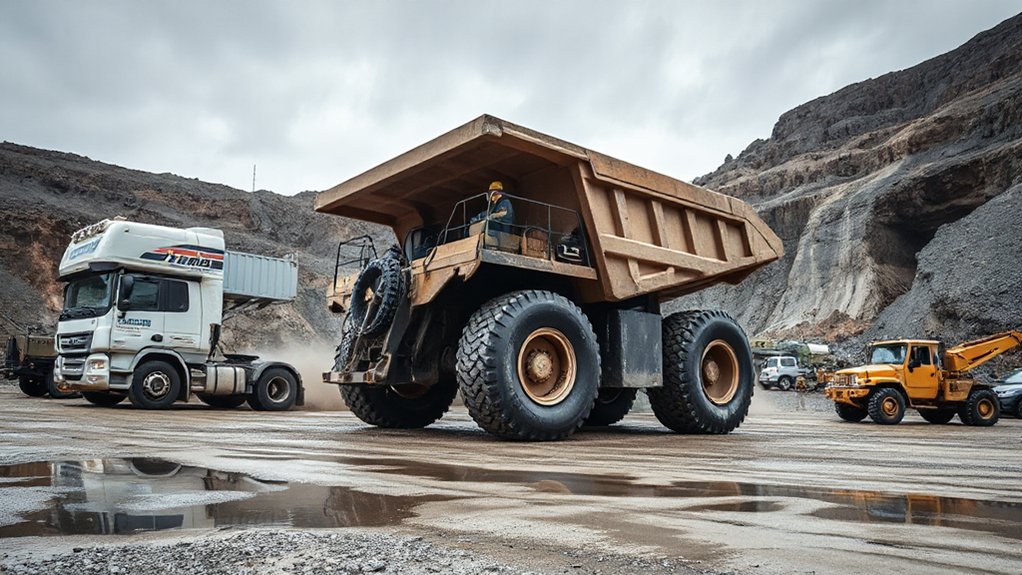
In the UK, a large dump truck generally means a rigid or articulated haulier designed to transport substantial volumes of excavated material, aggregate, or waste across construction, quarrying, and mining sites. You’ll identify one by its heavy-duty chassis, reinforced tipping body, high ground clearance, and powertrain engineered for demanding off-road cycles.
Classification depends less on a single legal threshold than on operating capacity, dimensions, axle configuration, and site conditions. A rigid truck suits predictable haul routes and tighter manoeuvring areas, while an articulated unit provides flexibility over uneven ground.
You should also assess braking systems, visibility, emissions compliance, and ground-pressure limits before deployment. Environmental impact remains significant, particularly through fuel consumption, dust, noise, and carbon emissions.
Maintenance challenges include drivetrain wear, hydraulic faults, tyre damage, and structural fatigue.
The UK’s Largest Dump Trucks Ranked by Payload
Payload rankings vary by configuration, but the largest dump trucks operating on UK quarrying and mining sites typically carry between 30 and 100 tonnes per load.
At the lower end, articulated haulers around 30–40 tonnes suit confined quarries, variable ground, and shorter cycles. Rigid trucks in the 50–70-tonne class provide greater haul capacity for established roads and high-volume aggregate production.
The largest machines, rated near 90–100 tonnes, serve major extraction operations where wide benches, robust haul routes, and suitable loading equipment justify their truck size.
You should compare payload with body volume, power-to-weight ratio, turning radius, and operating costs rather than rank capacity alone.
Site gradients, material density, tyre availability, and legal transport limits also influence which truck delivers the best productivity.
Caterpillar Dump Trucks Used in UK Quarries
Caterpillar dump trucks give UK quarries a proven range of haulage options, from articulated models that handle uneven benches and tight working areas to rigid trucks designed for high-volume production. You can match each Haul truck to site geometry, material density, gradient, and loading equipment.
Articulated models provide traction and steering control on rough, wet routes, while rigid machines deliver high productivity on established haul roads. Their payload capacity supports efficient cycle planning, helping you balance excavator output, fuel consumption, and tyre wear.
Caterpillar’s electronic controls, automatic transmissions, and monitoring systems also help operators maintain consistent performance across demanding shifts. When you specify the right configuration, you’ll improve fleet utilisation and reduce avoidable delays.
Quarry managers should assess haul distance, maintenance access, braking requirements, and operator training before deployment.
Komatsu Dump Trucks Used on Major UK Sites
Komatsu dump trucks give major UK sites a strong alternative for high-volume earthmoving, quarrying, and infrastructure work. You’ll find rigid models supporting bulk excavation, overburden removal, and aggregate production where payload consistency and cycle efficiency directly affect project output.
Their high-capacity bodies, robust frames, and electronically managed powertrains help you maintain dependable performance across demanding haul roads and variable ground conditions. Operators can use onboard monitoring to track fuel consumption, payload, and machine health, allowing earlier intervention and better fleet planning.
Vintage models remain active on some established sites, although parts availability and outdated emissions systems can create maintenance challenges. You’ll need disciplined inspections, planned component replacement, and competent technicians to control downtime.
Komatsu’s dealer support and diagnostic capability can strengthen reliability when you match servicing intervals to site conditions and operating hours.
Volvo A60H Articulated Dump Trucks
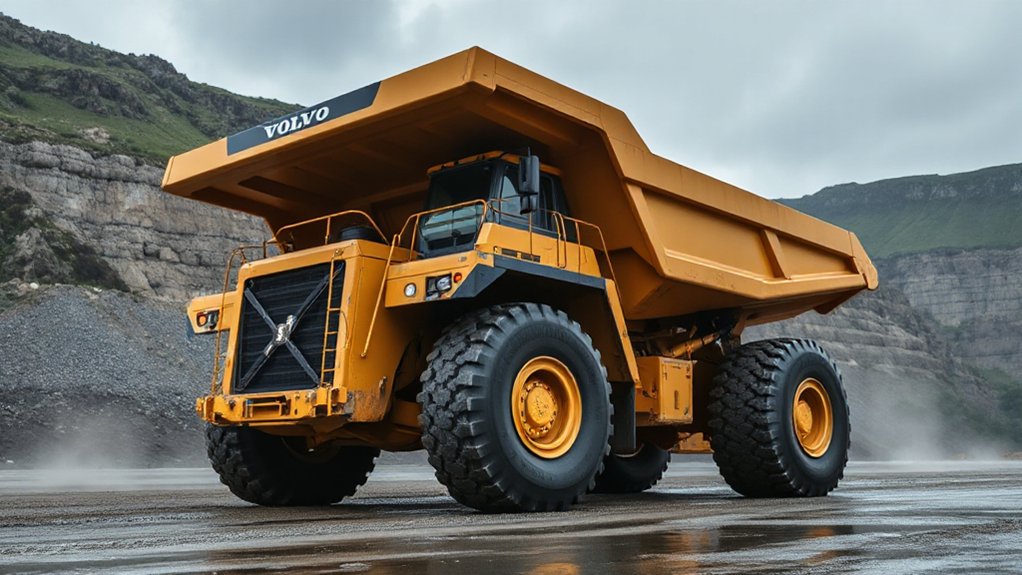
With the Volvo A60H, you get powerful hauling capacity for high-volume earthmoving and quarry operations across the UK. Its articulated design, all-wheel drive, and advanced traction systems help you maintain productivity on steep, uneven, and muddy terrain.
You’ll benefit from controlled off-road performance, even when site conditions challenge conventional rigid dump trucks.
Powerful Hauling Capacity
When demanding earthmoving projects call for maximum payloads, the Volvo A60H articulated dump truck delivers a 55-tonne rated load capacity and a 33.6 m³ heaped body, enabling you to move more material per cycle.
Its robust frame, high-torque powertrain, and carefully matched transmission help you maintain productive haulage rates across demanding UK construction, quarrying, and infrastructure projects.
You can optimise each pass by pairing the body volume with material density, reducing partial loads and unnecessary cycles.
The A60H’s payload capability also supports efficient fleet planning, allowing fewer trucks to achieve targeted production.
Although fuel efficiency depends on site conditions, loading practices, and operator behaviour, consistent utilisation improves cost per tonne.
Durable components and accessible service points can help control maintenance costs, supporting dependable availability throughout intensive operating schedules.
Advanced Off-Road Performance
High payloads deliver value only when the truck can maintain traction and stability across difficult ground. With the Volvo A60H, you get articulated steering, automatic traction control, and six-wheel drive to negotiate mud, gradients, loose aggregate, and uneven haul roads confidently.
Its robust frame and purpose-built suspension keep the body controlled, reducing spillage and maintaining operator comfort over long cycles. You can select drive modes that match surface conditions, while the transmission manages torque delivery and downhill control.
These systems help you sustain production when rigid haulers would struggle. Autonomous technology could further improve route consistency, obstacle awareness, and site safety as deployment develops.
You’ll also reduce Environmental impact through efficient power management, fewer recovery events, and lower tyre wear, supporting more responsible UK operations without compromising payload performance.
Rigid Dump Trucks for UK Quarry Work
When you select rigid dump trucks for UK quarry work, match their chassis, tyres, and tipping body to abrasive ground and demanding haul routes.
You’ll need sufficient payload capacity and engine performance to move aggregate efficiently across gradients and varying distances.
The following sections assess quarry-specific configurations and their impact on haulage productivity.
Quarry-Specific Rigid Trucks
Quarry-specific rigid trucks are engineered for the abrasive, high-cycle demands of UK aggregate sites, combining robust frames, high ground clearance, reinforced bodies, and drivetrains sized for steep haul roads.
When you specify one, prioritise sealed electrical systems, heavy-duty suspension, articulated steering, and corrosion-resistant materials suited to wet, abrasive conditions.
Electric innovation is also reshaping quarry fleets, with battery-electric prototypes and hybrid systems reducing local emissions, noise, and maintenance demands around processing areas.
You’ll need safety features that support controlled operation, including high-visibility access points, certified rollover protection, machine cameras, proximity detection, automatic braking, and stable three-point contact.
Select a truck with telematics that tracks condition, inspections, and operator behaviour.
UK quarry compliance, site geometry, service support, and parts availability should guide your final specification.
Payload And Haulage Performance
Payload and haulage performance determine how efficiently a rigid dump truck converts engine power, body capacity, and cycle time into productive tonnes moved. In UK quarries, you should match rated payload to material density, fragmentation, haul-road gradients, and loading-tool capacity.
Underloading wastes each cycle; overloading accelerates tyre, brake, suspension, and drivetrain wear while increasing Mining safety risks. Measure payload consistently with onboard weighing, then compare cycle times, fuel burn, and availability to identify bottlenecks.
High torque at low engine speed helps you climb ramps efficiently, while retarding systems control descents without excessive brake temperature. You should also assess turning radii and traction on wet, uneven surfaces.
Optimised payloads reduce fuel consumption per tonne and environmental impact, supporting compliance, predictable costs, and sustained quarry output across demanding UK operating conditions.
How Much Can UK Dump Trucks Carry?
UK dump truck capacity typically ranges from 1 tonne for compact site dumpers to more than 100 tonnes for large quarry haulers, although most construction projects use models carrying 6–30 tonnes. You should assess payload against material density, body volume, axle limits, and ground conditions rather than relying on headline figures.
Articulated dump trucks commonly handle 25–45 tonnes, while rigid quarry trucks can exceed 90 tonnes under controlled operating conditions. Manufacturers specify rated payloads to protect structural integrity, braking performance, tyres, and drivetrain components.
Overloading increases the environmental impact through higher fuel consumption, tyre wear, and emissions, while underloading reduces productivity. You’ll also face maintenance challenges if repeated overloading accelerates suspension, frame, hydraulic, and transmission wear.
Always verify site rules, weighbridge data, and legal road limits before loading.
Why UK Sites Use Large Dump Trucks
Large dump trucks give UK sites the production capacity needed to move high volumes of overburden, aggregate, spoil, and other bulk materials efficiently. When you’re operating major quarries, infrastructure projects, or large earthworks, their payloads reduce vehicle movements, loading cycles, and haulage time.
You’ll also improve fleet productivity by matching truck capacity with excavator output, keeping loading and tipping operations balanced. Articulated designs provide traction and stability across uneven, wet, or confined UK terrain, while advanced braking and operator systems support safer working.
However, you must assess Environmental impact, including fuel consumption, emissions, noise, and ground disturbance, before selecting equipment. You’ll also face Maintenance challenges, from tyre wear and hydraulic servicing to planned downtime.
Effective scheduling, inspections, and operator training protect availability, compliance, and whole-life cost.
Frequently Asked Questions
What Licences and Qualifications Are Required to Operate Large Dump Trucks in the UK?
You’ll need Licensing requirements: a valid CPCS or NPORS card, site induction, and Operator training for the specific dump-truck class. Public-road use additionally requires the appropriate DVLA licence, registration, insurance, and compliance checks.
How Much Does It Cost to Hire or Purchase a Heavy Dump Truck?
Hiring a heavy dump truck typically costs £1,000–£3,000 daily; purchasing ranges from £150,000 to over £500,000. What fits your budget? Compare payload, Fuel efficiency, emission standards, operator costs, maintenance, insurance, and transport.
What Safety Features Protect Dump Truck Operators on UK Worksites?
You’re protected by roll-over protective structures, seatbelts, cameras, proximity alarms, improved visibility, emergency stops, and secure access systems. Safety protocols and operator training reduce collision, overturn, loading, and maintenance risks across UK worksites.
How Are Large Dump Trucks Transported Between Quarries and Construction Sites?
Thou’lt transport large dump trucks on specialist low-loaders, securing articulated components and checking route restrictions. You’ll prioritise Load securing, permits, escorts, and fuel efficiency, while coordinating quarry-to-site deliveries to minimise downtime, disruption, and risk.
What Maintenance Schedules Do Heavy Dump Trucks Require in UK Conditions?
You’ll need daily inspections, weekly lubrication, and scheduled servicing based on hours and manufacturer guidance. In UK conditions, monitor brakes, tyres, hydraulics, emissions, and corrosion; provide Operator training and comply with environmental regulations.
Conclusion
Choosing the right dump truck transforms productivity across UK quarries and major construction sites. Whether you’re deploying Caterpillar, Komatsu, Volvo, or a rigid-frame heavyweight, you’ll gain the payload, traction, and reliability needed for demanding haul cycles. Match capacity to haul roads, loading equipment, and site constraints, then use telematics to control costs and downtime. These machines aren’t merely large—they’re earthmoving giants capable of shifting mountains efficiently, safely, and consistently when properly managed.