
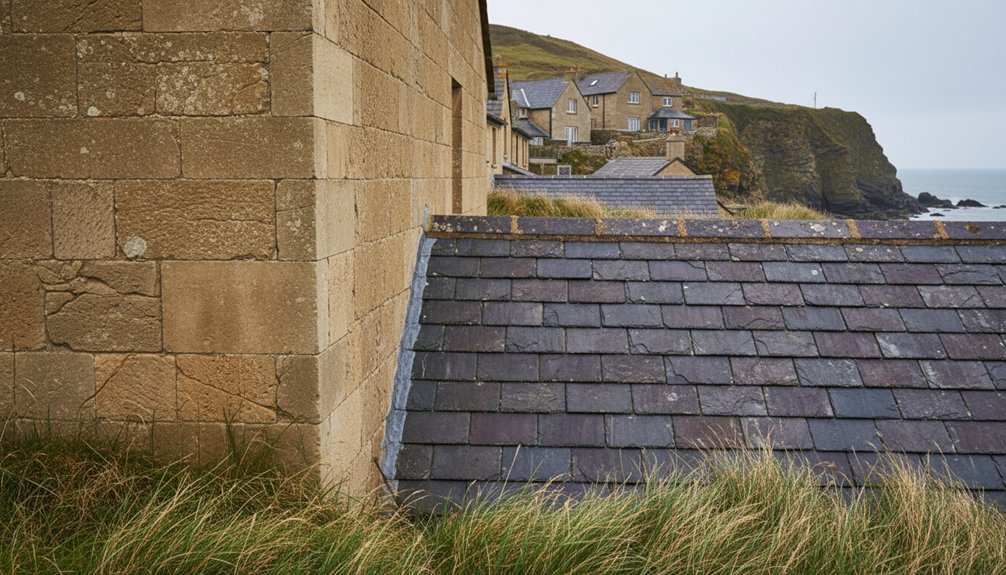
From honey-coloured Bath Stone to rugged Cornish Slate, the UK’s regional building materials have shaped an almost unmatched architectural legacy. You’ll find that each stone or slate combines distinct mineral properties, weathering behaviour, detailing requirements, and conservation considerations. Comparing them properly means evaluating durability, porosity, compressive strength, provenance, and embodied carbon—not just appearance. Whether you’re specifying a roof, façade, or repair, one overlooked characteristic can determine long-term performance, and the differences become clearer as you examine each material.
Key Takeaways
- Bath Stone provides a fine-grained, honey-golden finish, ideal for ashlar, carving, façades, and traditional architectural detailing.
- Cotswold Limestone offers distinctive cream, buff, and muted-gold tones, but requires careful attention to porosity, frost resistance, and lime mortar.
- Portland Stone suits landmarks and façades, while durable Yorkstone is particularly effective for paving, steps, and heavily trafficked areas.
- Welsh Slate combines low water absorption and frost resistance with long service life when correctly specified for roof pitch and exposure.
- Cornish Slate delivers rugged texture and regional character; verify grading, thickness, water absorption, fixings, and conservation compatibility before installation.
Why Local Stone and Slate Still Matter
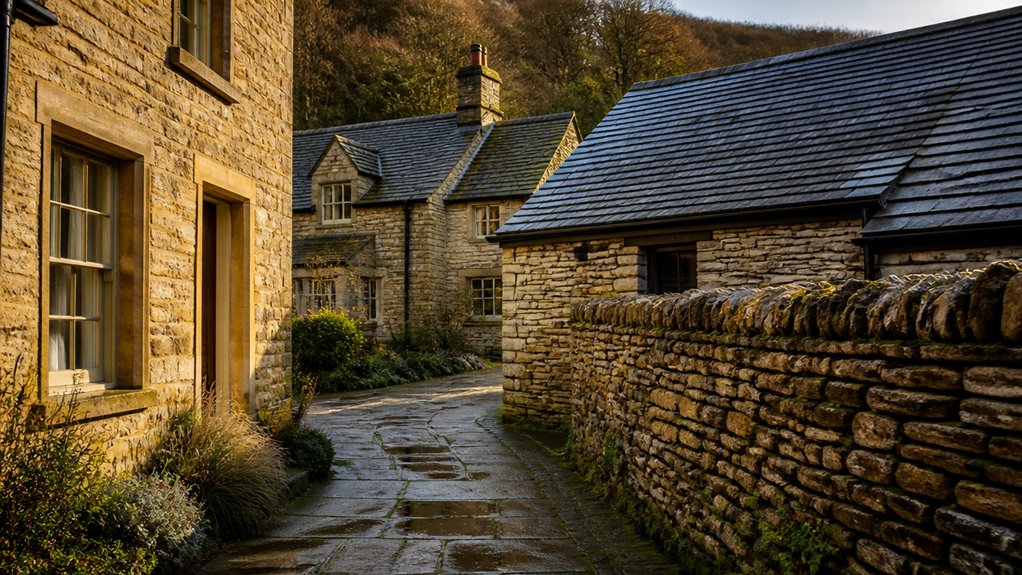
Local stone and slate still matter in UK construction because they suit regional climates, traditional building methods, and conservation requirements. When you specify materials from nearby quarries, you can match local geology, colour, texture, and weathering behaviour more accurately. That compatibility helps repairs blend with existing masonry and reduces risks from incompatible permeability or thermal movement.
You’ll also support sustainable sourcing by shortening transport distances and selecting suppliers who can demonstrate responsible extraction, restoration plans, and documented provenance. Regional materials often require skilled cutting, dressing, and laying, so your project helps retain specialist craft knowledge and local employment.
Their cultural significance strengthens place identity, particularly in protected areas and historic townscapes. Use them where planning conditions, conservation principles, and performance demands align, while confirming structural properties, frost resistance, grading, and installation details before procurement.
How to Compare UK Building Materials
How should you compare UK building materials? Start with performance, not appearance. Assess compressive strength, flexural resistance, water absorption, frost durability, thermal movement, and expected service life against the project’s exposure and loading conditions. Check each product’s declared standards, test data, warranty, and maintenance requirements rather than relying on marketing claims.
Next, examine lifecycle cost. Include extraction, processing, transport, installation, cleaning, repair, and eventual replacement. Sustainable sourcing matters: verify quarry management, recycled content, environmental product declarations, and credible chain-of-custody information. Local availability can reduce transport impacts and improve continuity of supply.
Then consider workmanship and compatibility with adjoining systems, including mortar, fixings, insulation, and drainage. Finally, evaluate colour consistency, texture, format, and aesthetic versatility alongside planning constraints.
This structured comparison helps you select materials that meet technical, environmental, financial, and design objectives.
Bath Stone and Its Honey-Golden Colour
Bath Stone is an oolitic limestone recognised for its warm honey-golden colour, fine grain, and ability to weather into a softer, more varied patina. You’ll find its Honey golden hues arise from iron compounds and subtle mineral variation within the calcite-rich matrix.
Freshly quarried blocks typically appear relatively uniform, but exposure gradually deepens tonal contrast, helping façades develop visual character without losing cohesion.
When you specify Bath Stone, assess the Stone texture as well as colour. Its compact, workable structure allows precise sawing, carving, and ashlar finishing, while bedding direction affects performance and appearance.
Match blocks from the same source where consistency matters, because quarry seams can produce noticeable differences in grain and shade.
You should also confirm whether the material is suitable for external exposure, detailing, and local pollution conditions before installation. Proper jointing and compatible repairs will protect the stone’s colour and weathering behaviour.
Cotswold Limestone for Traditional Homes
Cotswold limestone gives traditional homes a softer, regionally distinctive character than Bath Stone, with colours ranging from pale cream and warm buff to muted golden tones. You’ll find its oolitic texture and variable grain create subtle visual movement across ashlar walls, quoins, mullions, and boundary features.
Choose locally appropriate stone to support traditional home aesthetics and comply with conservation-area expectations, particularly where planners require matching geology and coursing. Before specifying, check the quarry’s bedding orientation, frost resistance, porosity, and compressive strength; these properties affect durability and detailing.
Use lime mortar rather than rigid cement-based mixes, allowing moisture to evaporate through the joints and reducing edge spalling. You’ll also need to coordinate weathering details, including copings, sills, and drips, because limestone remains vulnerable to prolonged saturation and poorly managed runoff.
Portland Stone in Landmark Buildings

Portland Stone has shaped the identity of major UK landmarks, including St Paul’s Cathedral, Buckingham Palace, and the Bank of England, because its dense, fine-grained oolitic limestone provides a consistent pale finish and strong carving performance. When you assess Portland stone architecture, you’ll find it specified for façades, columns, cornices, balustrades, and sculptural details.
Its predictable bedding, workability, and durability support precise ashlar construction, while controlled quarry selection helps match colour and grain across elevations. However, exposure gradually causes weathering, staining, biological growth, and joint deterioration.
For Landmark preservation, you’ll need condition surveys, compatible mortar analysis, careful poulticing, and like-for-like stone replacement. Avoid aggressive abrasive cleaning or impermeable coatings: they can damage the surface and trap moisture.
Skilled masons should replicate profiles, tooling, and fixing methods so repairs remain technically sound and visually coherent.
Yorkstone for Paving, Steps and Streets
You’ll find Yorkstone provides durable paving, with its dense grain resisting heavy footfall and variable UK weather.
Use accurately gauged sections for steps and edges, allowing consistent risers, secure bedding, and effective drainage.
Its traditional street applications include footways, thresholds, kerbs, and civic surfaces where natural texture supports heritage character.
Durable Yorkstone Paving
Yorkstone paving is a durable, fine-grained sandstone suited to patios, paths, steps and streets, where its dense structure withstands heavy foot traffic, weathering and repeated freeze–thaw cycles.
You’ll find its muted buff, grey and golden tones complement both historic and contemporary settings. Select calibrated slabs for consistent joints and easier installation, or choose naturally riven pieces when you want traditional texture and slip resistance.
Specify adequate thickness for the expected loading, then lay the stone on a properly compacted, free-draining sub-base to limit settlement and frost damage.
Its proven performance reflects medieval quarrying, while modern restoration projects continue to value locally sourced Yorkstone for compatible repairs.
Seal only when necessary, because breathable, well-drained construction usually protects the surface better than an impermeable coating.
Regular sweeping and prompt stain removal will preserve its appearance.
Yorkstone Steps And Edges
For steps and edging, specify Yorkstone slabs with sufficient thickness, sound bedding, and accurately formed arrises to withstand concentrated loads and repeated weathering. Check each piece for consistent dimensions, manageable tolerances, and a surface finish that provides secure footing without creating trip hazards.
Set treads with a slight fall to shed water, and form risers plumb, evenly aligned, and securely supported. Use compatible mortar or a specified paving system, allowing adequate curing before loading the work.
At exposed corners, select stone with tight grain and avoid unsupported overhangs; a modest bullnose or eased arris can improve safety while retaining character.
Good Yorkstone craftsmanship depends on restrained detailing, accurate setting out, and careful handling. Protect edges preservation during installation by isolating finished arrises from plant, impact, staining, and aggressive cleaning.
Traditional Street Applications
Traditional street work demands more than attractive paving; it requires Yorkstone selected and installed for sustained traffic, drainage, and maintenance. You should specify dense, frost-resistant slabs with consistent thickness, then match the laying pattern to loading: coursed paving suits footways, while smaller units improve stability in trafficked areas.
Use a properly compacted, free-draining sub-base and an appropriate mortar or bound joint system; weak bedding invites rocking, settlement, and water ingress. Detail kerbs, thresholds, steps, and utility covers as one level-controlled assembly, preserving accessible gradients and safe edge restraint.
Modern installation can combine diamond sawing, mechanical lifting, and permeable construction without compromising the stone’s character. You’ll also reduce Environmental impact by reusing sound reclaimed Yorkstone, sourcing locally where possible, and designing for repair rather than replacement.
Maintain joints and replace damaged units individually to extend service life.
Welsh Slate for Durable Roofs
Welsh slate provides a durable, low-maintenance roofing material, valued for its low water absorption, high compressive strength, and resistance to frost, wind, and fire. When you specify it, you’ll gain a service life that can exceed a century, provided installation follows BS 5534 guidance and local exposure requirements.
Choose slate thickness, gauge, headlap, and fixing methods to suit roof pitch, wind uplift, and rafter spacing. Stainless-steel or copper nails help prevent premature corrosion, while competent detailing protects verges, valleys, abutments, and penetrations.
You can select consistent grades for uniform coverage or naturally varied pieces for visual depth. Eco-friendly sourcing reduces transport impacts when you choose responsibly quarried Welsh material, and modern aesthetic options include smooth sawn surfaces, calibrated formats, and contemporary colours.
Confirm structural loading and obtain samples before ordering.
Cornish Slate and Its Rugged Finish
Cornish slate offers a rugged, textured alternative to Welsh slate, with natural variation that suits exposed roofs and heritage projects. You’ll find its rugged texture reflects the stone’s mineral composition and split formation, producing a less uniform surface with strong visual character.
Before specifying it, check the quarry’s grading, thickness tolerances, and water-absorption data, because performance can vary between sources. Select consistent grades where you need orderly courses, or combine natural variation with traditional detailing for a more authentic finish.
Experienced roofers should assess slate cleavage, fixing requirements, and compatibility with battens and nails during installation. You’ll also need to confirm the product meets relevant British Standards and local conservation requirements.
Used correctly, Cornish slate gives roofs durable weather protection, distinctive texture, and a convincingly regional appearance.
Scottish Granite and Stone for Harsh Climates
When you specify Scottish granite, you gain exceptional compressive strength, abrasion resistance, and low porosity for demanding construction. Its mineral structure withstands Scotland’s rain, frost, salt exposure, and temperature changes with minimal weathering.
You’ll find it used traditionally in masonry, paving, kerbs, façades, and structural features.
Granite’s Exceptional Durability
Scottish granite withstands harsh climates because its dense crystalline structure resists freeze–thaw damage, abrasion, and moisture penetration. When you specify it, you gain a hard-wearing material suited to paving, steps, kerbs, façades, and memorials.
Its interlocking quartz and feldspar grains provide high compressive strength, while low porosity limits water uptake and staining. Ask your supplier for documented durability testing, including water absorption, frost resistance, and slip performance, so you can match the grade to its intended use.
Correct fabrication also matters: precise cutting prevents weak edges, and competent granite polishing produces a sealed, maintainable surface without compromising its natural character. You’ll need robust bedding, joints, and drainage to support the stone’s performance.
Select thickness and finish according to loading, traffic, and safety requirements, not appearance alone.
Weathering Scotland’s Climate
Although Scotland’s wet, wind-exposed conditions can accelerate deterioration, properly specified granite and other durable stone remain reliable when you account for freeze–thaw cycles, driving rain, salt, and surface abrasion.
For effective Climate adaptation, you should assess porosity, water absorption, mineral composition, and frost resistance rather than selecting stone by appearance alone.
Dense Scottish granite generally limits moisture ingress, but poorly detailed joints, copings, and flashings can still trap water and trigger cracking. Specify compatible mortar, adequate falls, drip details, and ventilated cavities to manage runoff and drying.
Near coasts, evaluate salt crystallisation and wind-driven sand abrasion, then choose a suitable finish and maintenance regime.
You’ll improve Weather resilience by sealing vulnerable interfaces, inspecting exposed elevations regularly, and replacing damaged units before defects spread through the surrounding masonry during severe weather events.
Traditional Stone Applications
Traditional stone applications in Scotland combine granite’s compressive strength, low porosity, and abrasion resistance with detailing suited to severe exposure. You’ll find it used for civic façades, bridges, harbours, boundary walls, kerbs, steps, and heavy-duty paving, where freeze–thaw cycles, driving rain, and salt demand durable construction.
Select stone by petrographic quality, water absorption, slip resistance, and anticipated loading, not appearance alone. Specify compatible mortar, generous copings, drip details, and restrained joints to limit water ingress and staining.
Local quarrying techniques influence block size, grain orientation, and achievable finishes; split, bush-hammered, and flame-textured surfaces provide robust weathering and safer foot traffic. You’ll also preserve cultural significance when you match regional granite, coursing, and traditional tooling to existing townscapes.
Proper setting-out and concealed drainage protect performance without compromising authenticity or future maintenance access.
How to Choose Stone or Slate
Choosing between stone and slate starts with matching the material to the building’s structure, exposure, and intended appearance. Assess the wall’s load-bearing capacity, local rainfall, freeze-thaw risk, and roof pitch before selecting a product.
Dense sandstone or granite suits heavy masonry and severe weather, while Bath Stone works best where its softer texture and pale finish complement the design.
For roofing, choose slate with documented thickness, strength, and water-absorption performance; steeper pitches generally improve drainage and service life.
Prioritise material sourcing from reputable quarries, because geological variation affects colour, durability, and workability.
Check planning requirements, especially in conservation areas, where local character may dictate approved materials.
Finally, plan stone preservation from installation onward: specify compatible mortar, adequate detailing, and gentle cleaning rather than harsh treatments that damage the fabric.
Frequently Asked Questions
How Much Does Regional UK Stone and Slate Typically Cost per Square Metre?
You’ll typically pay £40–£150 per square metre for regional UK stone, or £60–£180 for natural slate, excluding installation. Your cost comparison depends on finish, thickness, transport, and sourcing challenges; reclaimed materials often cost more.
Can Reclaimed Stone and Slate Be Used in Modern Construction Projects?
Yes, you can use reclaimed stone and slate in modern construction, provided you verify structural capacity, provenance, contamination, and frost resistance. You’ll gain reclaimed durability and aesthetic appeal, while meeting current building regulations.
What Maintenance Do Natural Stone Walls and Slate Roofs Require?
You’ll need regular inspections, gentle stone cleaning, repointing deteriorated mortar, and prompt crack repairs. Maintain slate roofs by replacing slipped tiles, clearing gutters, checking flashings, and applying slate sealing only when manufacturer-approved to preserve breathability.
Are Planning Permissions Needed When Using Regional Building Materials?
Roughly 20% of England lies within conservation areas, so you’ll often need planning permission before using regional materials. Check local policies, building regulations, and permit application processes; your council may require samples, drawings, or heritage approval.
How Environmentally Friendly Are Locally Sourced Stone and Slate Products?
You’ll usually reduce embodied carbon by choosing locally sourced stone and slate, thanks to shorter transport distances and durable service life. However, sustainability benefits depend on quarry practices, while sourcing challenges include limited availability, processing energy, and certification.
Conclusion
Choose your material by matching performance to place, not by appearance alone. Assess geology, porosity, frost resistance, load capacity, finish, maintenance, and conservation requirements before you specify. Bath and Cotswold limestone bring warmth; Portland Stone offers proven civic durability; Welsh and Cornish slate protect roofs with distinctive character; Scottish granite withstands severe exposure. Source responsibly, confirm compatibility with existing masonry, and use skilled contractors. Done well, your choice becomes both a sound investment and a lasting regional signature.