
- Key Takeaways
- The Marble Quarrying Process
- A Historical Perspective
- Global Quarrying Landscape
- Environmental Stewardship
- The Human Element
- Choosing Quarried Marble
- Conclusion
- Frequently Asked Questions
- How is marble quarried from the earth?
- What are the main stages in the marble quarrying process?
- How does marble quarrying impact the environment?
- Which countries are the major producers of quarried marble?
- What safety measures protect workers in marble quarries?
- How can I tell if quarried marble is responsibly sourced?
- Is natural quarried marble a good choice for long-term use?
Key Takeaways
- Marble quarrying follows a complete value chain from geological assessment and extraction to block handling, waste valorization, and site reclamation. Understanding every stage helps professionals and buyers evaluate both quality and environmental performance. Readers can use this step-by-step view to ask more precise questions when selecting suppliers or planning projects.
- Today’s quarries use diamond wire cutting, digital mapping, heavy machinery and closed-loop water systems, which make the work more precise, safer and more resource efficient than old-school methods. Decision-makers can favor quarries that show they keep their equipment and process control up to date when they source marble.
- Sustainable practices such as waste reuse, ecological impact monitoring and structured site reclamation are increasingly being considered core operational obligations rather than elective extras. Architects, developers and clients can support marble from quarries that recycle by-products, minimize emissions and re-landscape after quarrying.
- The world’s marble landscape is defined by traditional regions such as Carrara, Penteli, and Makrana, as well as new players in China, Iran, and Turkey, all presenting unique aesthetics and performance. Buyers may tailor project requirements by choosing not only color and pattern, but by also selecting source, geological characteristics, and verified production standards.
- Quarrying has important social and economic impacts on local communities, which is why worker safety, ethical employment, and transparent community relations are at the heart of conscientious marble manufacturing. Stakeholders can demand proof of safety protocols, community initiatives, and local benefits over time in partnerships with quarry operators.
- Considering quarried marble for your next building or design project is a tradeoff between aesthetics, functional use, durability, maintenance, and sustainability. Readers can use a handy checklist that checks quality grading, finish type, source reputation, and sustainability documentation before making that final material selection!
===
Quarrying marble is the extraction, loading and transporting of marble blocks from stone deposits underground. Workers apply drills, diamond wire saws and controlled blasting to fracture large sections from the quarry face with less waste and less risk than before.
Most modern sites monitor block quality with digital scans and maintain rigorous safety and dust control regulations. To provide clearer context, the following sections describe each major step in the quarrying process.
The Marble Quarrying Process
The marble quarrying process spans from initially finding the stone to generating finished slabs and it unites geology, engineering, and environmental stewardship in a single workflow.
-
Locate marble-bearing strata with field surveys, satellite imagery, and previous records.
-
Carry out geological assessment to test quality, thickness, and structural stability.
-
Obtain permits, conduct environmental-impact studies, and plan the quarry and access roads.
-
Open the quarry bench, drill anchor holes, and install diamond wire cutting systems or other extraction tools.
-
Slice off primary blocks from the rock mass, frequently using diamond wire, and isolate them with controlled wedges or small blasts.
-
Transport raw blocks with loaders and cranes to the yard, where they are sorted, marked, and stored.
-
Saw blocks into slabs on gang saws or multi-wire machines. Then handle slurry and offcuts.
-
Polish slabs with progressive abrasives, apply resins if required and surface grade.
-
Ship finished slabs and tiles while diverting chips, dust, and broken stone into reuse streams.
-
Reclaim benches and pits through backfilling, shaping of slopes, and replanting of native species.
1. Geological Assessment
The geological evaluation determines whether a marble body is even worth being quarried. Crews map mineral content, color uniformity, grain size and veining or cracking patterns, as these features determine whether a block will be turned into architectural cladding, floor tile or luxury sculpture stone. Labs might check strength, water absorption or frost resistance to accord deposits with actual building applications.
Field geologists map the outcrop, log fractures and folds, and trace layer changes across the site. They study rock fabric and texture in fresh cuts, contrasting lighter, fine-grained marbles for interiors with sturdier, slightly coarser varieties better adapted to load-bearing or outdoor work. Digital mapping tools and drones now assist in building three-dimensional models of benches and joints, indicating where large, defect-free blocks are most probable.
Geological history informs site selection. At sites such as Carrara, 2,000 years of quarrying have already tested the stone, but contemporary surveys continue to fine-tune where to push outward while avoiding difficult slopes. Meanwhile, ecological evaluation considers hydrology, erosion, and ecological threat, observing that antiquated processes in heritage areas frequently resulted in habitat destruction and profound topographical alteration. All new projects have to demonstrate how they will restrict such impacts prior to extraction commencing.
2. Extraction Techniques
Extraction has shifted from hand tools to precise cutting systems, though the basic aim is the same. The goal is to free large, sound blocks with as little damage as possible.
In ancient Greek and Roman quarries, workers used chisels, hammers, and wedges to trace out natural cracks. Romans streamlined this into the “panel” method, making 15 to 20 centimeters deep cuts following a predetermined line, then pounding chisels to detach a block. These methods were sluggish and generated a lot of waste rock, with recoverable content occasionally at 20 percent.
Modern sites select methods according to the marble type, bench height, and block size. For Carrara marble and many other high-end stones, the cutting technique of choice is diamond wire cutting, which came along in the 1970s and superseded many older saws and blast-based methods. A steel cable, embedded with diamond-coated beads, snakes through drilled holes and slides at a metered pace, slicing with approximately 98% accuracy along a predetermined plane. It produces fresh, clean faces, minimizes microcracks, and increases the usable yield to approximately 75 to 80 percent in well-managed quarries.
Controlled blasting is still employed in harder or lower grade areas, but it is kept light to prevent fracturing. Many operators combine drilling, wire cutting, and small charges. Wires outline the block, then low-intensity blasts or hydraulic jacks push it free. Safety rules mold each decision from bench design and catch berms to dust control and noise limits, all of which impact nearby communities and long-term site sustainability.
3. Block Handling
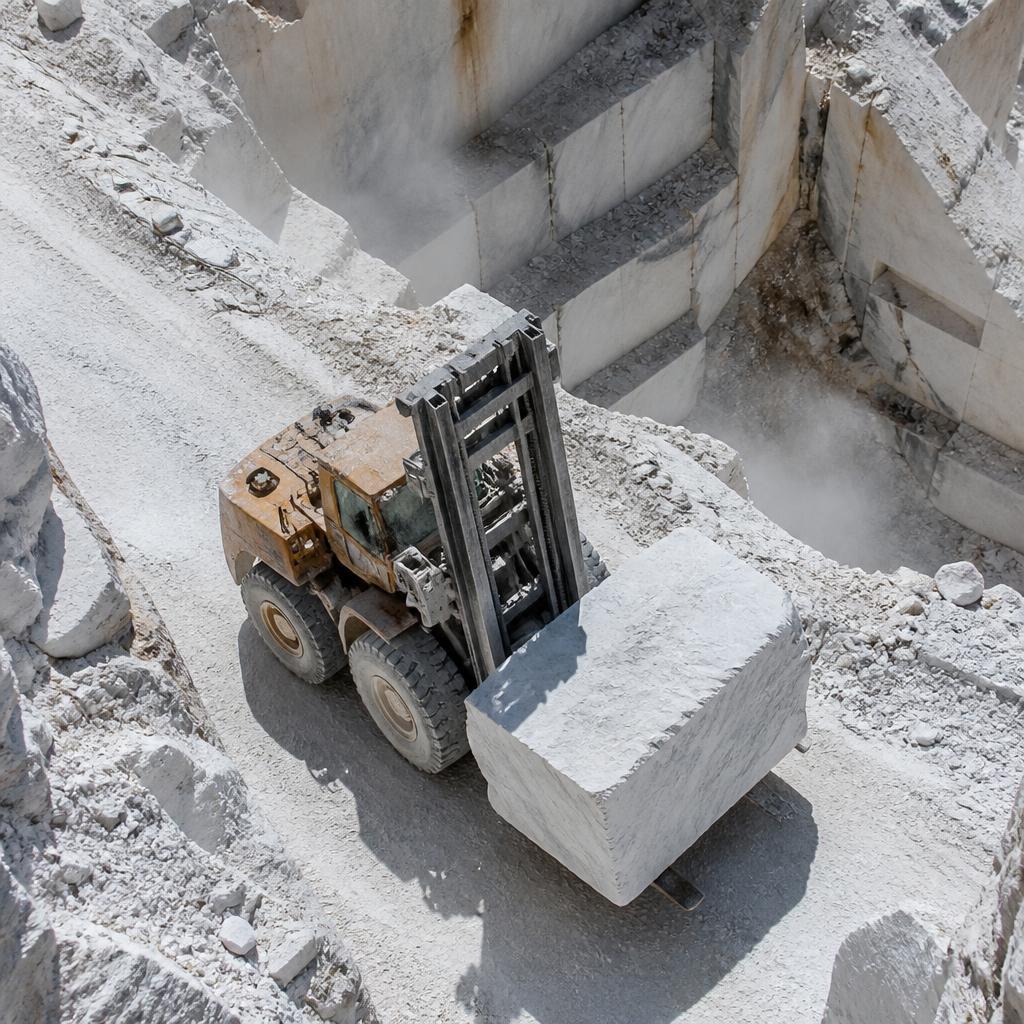
As soon as a block is released, block handling maintains that value. They use heavy loaders, crawler excavators, and mobile cranes to lift blocks, sometimes over 20 tonnes, and transport them from the quarry face to staging areas and then to the processing yard. Operators design haul roads with gradual grades and broad turn radii to reduce the chances of rollovers or stones being dropped.
In the yard, crews examine every block for cracks, color bands, and shape. They give each its own ID, usually a barcode or RFID tag, so every piece can be tracked from bench to finished slab in a warehouse. That tracking helps buyers match lots for large projects and it feeds data back to geologists about which parts of the bench provide the best stone.
Blocks then proceed to sawing, the second primary stage following extraction. Multi-wire saws cut them into slabs of predetermined thickness, say 20 mm or 30 mm, while offcuts and breakage are reserved for reuse streams such as tiles or small architectural pieces. Raw blocks don’t yet exhibit that polished glow. Meticulous stacking on flat padded surfaces and shielding protection from pooling water prevents stains or edge chipping that would appear later when polished.
4. Waste Valorization
Even through streamlined cutting, marble quarrying nevertheless still generates significant waste, from ragged chips to fine slurry amounting to about 4 to 5 percent of block output. Waste valorization seeks to transform as much of this as it can into valuable products rather than dumps.
Quarries pulverize offcuts into aggregates for concrete, road bases, and precast blocks. They mill finer material into powders for industrial minerals. Others press marble chips and binders into reconstituted tiles, stairs, or window sills that maintain a stone appearance while utilizing what was once a liability.
|
By-product type |
Typical size / form |
Common uses |
|---|---|---|
|
Coarse offcuts |
30–300 mm pieces |
Gabion fill, landscape walls, decorative rock |
|
Crushed aggregate |
4–32 mm graded chips |
Concrete, road sub-base, drainage layers |
|
Fine chips |
2–8 mm |
Terrazzo floors, reconstituted tiles, mosaics |
|
Marble powder |
< 2 mm and slurry-derived fines |
Paints, plastics filler, agriculture lime, cement additives |
Innovations continue to drive new applications, ranging from soil conditioners and acid-neutralizing agents to 3D-printed composite panels that combine marble dust with resins. For a young pro eyeing sustainability, these projects demonstrate how circular thinking can slide into a very old industry.
5. Site Reclamation
Site reclamation is the last phase in a quarry’s life. It should be planned while extraction is still taking place to keep land-use changes grounded and funded. Operators plan to backfill worked-out benches with inert material, regrade slopes to stable angles, and restore topsoil where it was stripped and stockpiled earlier in the project.
Good plans attempt to regenerate native plant cover instead of adding ornamentals that may be non-native. For most European and North American quarries, this involves planting native grasses and shrubs initially, followed by trees that are consistent with surrounding forest areas. Amphibians and birds might be supported by shallow ponds sculpted from old pits, and rock faces that are once safe can provide nesting niches or climbing zones.
Some abandoned marble quarries are converted into parks, climbing areas, or even open-air theaters — once a harsh industrial space, now communal. Continued monitoring tracks erosion, groundwater quality, and plant survival. If initial results are lacking, follow-up adjustments occur. Deep-rooted traditions in Carrara, where generations of quarrying reshaped whole valleys, have driven both regulators and operators to regard reclamation as more than a legal obligation.
It is also a means of restoring some of that prior loss in biodiversity and landscape connectivity.
A Historical Perspective
Marble quarrying reflects how tools, commerce, and design preferences evolved from hand-hewn blocks for temples to our current global stone trade driven by machinery and algorithms.
Ancient Methods
Early quarry crews in Greece, Rome, and around the eastern Mediterranean used simple hand tools: iron hammers, pointed and flat chisels, and wooden or metal wedges tapped into shallow grooves. They cut channels around a block, drove in wedges, and counted on natural fractures and gravity to release the stone. This laborious work required expertise, as one poorly aimed swing could fracture an almost complete block and squander weeks of work.
Greek builders sourced marble from Mount Pentelicus near Athens and the island of Thasos. Pentelic marble furnished much of the Parthenon’s stone, while Thasos gained fame for pale-hued stone adorning temples and public spaces. Romans took this concept to a higher level by establishing entire quarry districts and regular paths to transport blocks down mountain paths to ports and onto cities around the empire.
Iconic locations like the Pentelic quarries, the Thasos quarries, and the early Carrara quarries in Italy became enduring industrial landscapes. The Carrara region, where quarrying started more than two millennia ago, developed into a primary supply for Roman-era monuments and later for Renaissance sculpture. Marble’s granular texture, stable grain, and receptivity to a hard polish made it the stone of choice for statues, sarcophagi, floor inlays, and wall veneers that communicated wealth and civic pride.
Even then, marble served as a status symbol. Temples, baths, and villas boasting bright polished columns or sculpted friezes broadcast power and resources, while plainer structures remained with local limestone or brick.
Industrial Revolution
With the Industrial Revolution, quarrying moved beyond muscle to steam and steel in large parts of Europe. Steam-powered drills and winches accelerated cutting and lifting, while narrow-gauge railways transported blocks from mountain faces to coastal ports more securely than ox-drawn carts on treacherous dirt roads.
Production increased to cater to demand for marble in Victorian town halls, railway stations, cathedrals, and gravestones. Straight slabs and tiles paved floors and staircases in government halls, hotels, and banks, transforming marble from a precious elitist material into a commonplace part of public life.
Exports grew from traditional hubs such as Carrara to new destinations in northern Europe and subsequently in North America. Quarries proceeded in the direction of more standardized block sizes, which gave urban workshops the ability to saw, polish, and ship consistent products for expanding city building schedules.
Modern Era
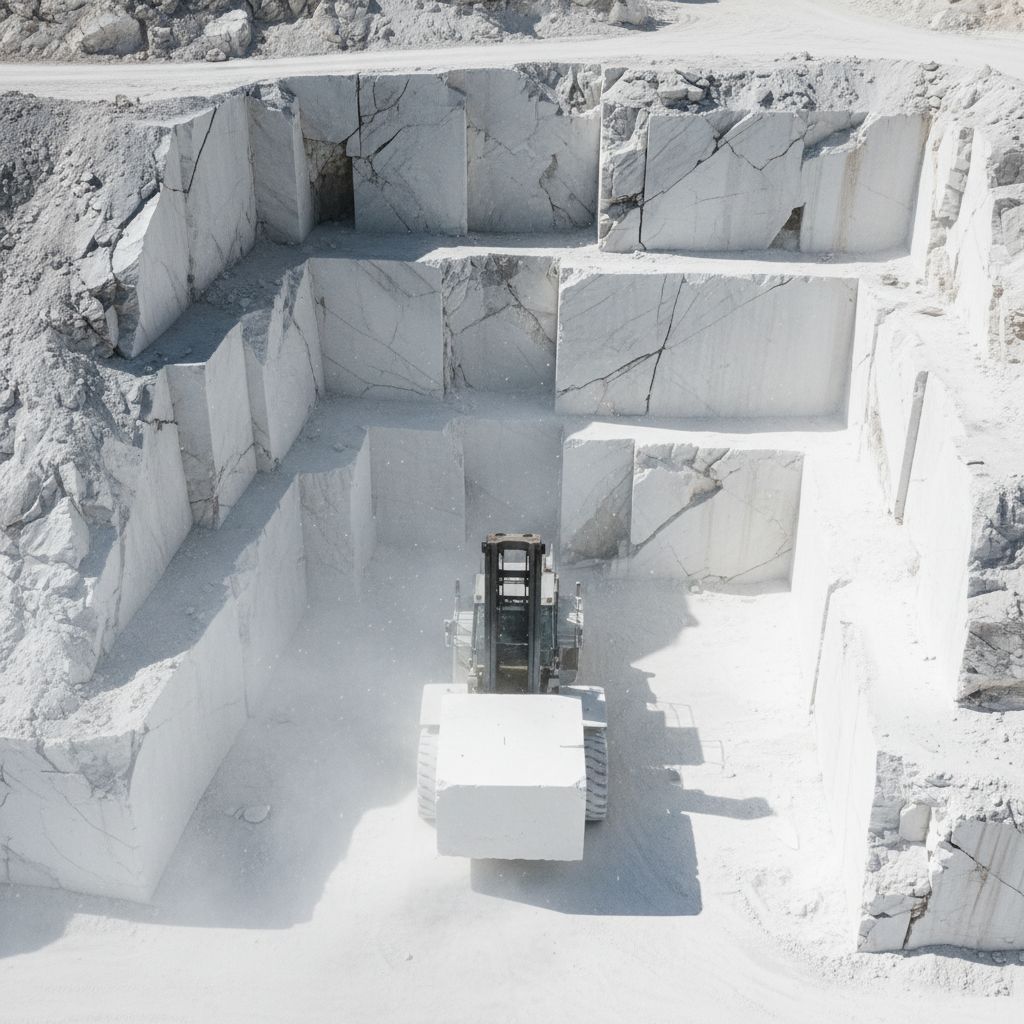
By the late 20th century, diamond wire cutting, track-mounted saws, and heavy excavators reshaped quarry faces in Carrara and Thasos. Thin diamond-embedded cables that run through drilled holes slice cleaner, larger blocks with less breakage than hammer and wedge. Digital mapping and 3D models allow engineers to plan benches, access roads, and slope stability well in advance instead of operating by guess and habit.
The Carrara quarries, today covering more than 5 km² of mountain, continue to feed elite markets with grades like the pure white ’Statuario’ and veined ’Calacatta’. Some of the first chemical analyses of Italian marbles were conducted in the 18th century, and chemists in modern laboratories can now trace stone back to specific zones within quarries. This factor is important for restoration efforts and verifying provenance.
International commerce transports marble from quarry belts across Italy, Greece, Turkey, India, and beyond to design studios and construction sites around the world. Exotic colors and high gloss kitchens, hotels, and office lobbies have strong demand, even when the stone journeys thousands of kilometers from source to site.
This expansion has an obvious ecological price. On Thasos, for instance, the visual quarry footprint extended to approximately 13.5% of the island by 2000, approximately five times the area in 1984. There were forest fires that burned up half the island in that period, moving quarry pits into the remaining forest.
Simultaneously, hundreds of years of ancient dirt in age-old districts like Carrara now mulch over accessible marble and obstruct simple entry to blocks. Modern regulations drive quarries in the direction of improved waste management, slope reclamation, and water management, but implementation remains inconsistent across countries and companies.
Global Quarrying Landscape
Marble quarrying today occupies a close global landscape, where heritage sites, trade routes, and environmental activism are all intertwined. The very stone that carves national monuments fuels local livelihoods, export revenues, and centuries-old debates over land use and landscape scars that folks have been noticing since Roman times.
Iconic Regions
Carrara (Italy), Penteli (Greece), and Makrana (India) are some of the most researched marble fields. Carrara’s high-purity calcite beds in the Apuan Alps provide a cool white stone with fine, even grains and subtle gray veining. It has been quarried since the first century BC and continues to sustain a dense cluster of quarries, sawmills, and sculpture ateliers.
Penteli, near Athens, produces a warm white marble with a subtle honey hue from the iron-containing minerals. This marble has been used in classical temples and subsequent restorations. Makrana in Rajasthan yields compact, low-porosity marble, typically brilliant white with gentle gray veins. This marble withstands scorching, dusty environments.
These areas helped demarcate what “quality” marble designates. Carrara furnished the Pantheon and Trajan’s Column in Rome, Michelangelo’s David, and newer civic buildings throughout Europe and North America. Pentelic marble constructed the Parthenon and much of the Acropolis, and its application in contemporary restoration efforts maintains demand.
Makrana marble, which makes the Taj Mahal and many Mughal-era palaces, still ships in large quantities for flooring and cladding all over South Asia and the Middle East. Geology and local craft both define their renown. Thick, well-bedded carbonate formations provide the large, workable blocks, and extensive training lines instruct you how to read fracture patterns, cut with foliation, and minimize waste.
The same operations transform mountain skylines and valley floors. On the Greek island of Thasos, remote sensing revealed quarry areas expanding to nearly five times their 1984 footprint by 2000. Even where total area remains small, slopes, road cuts, and spoil piles can alter the character of a landscape in ways nearby residents and visitors perceive.
United Kingdom
British ‘marbles’ are typically polished limestones and breccias. There remains an evident role for them in the quarrying narrative. Purbeck Marble from Dorset brags fossil shells that provide a speckled appearance. Frosterley Marble of Co. Durham reveals white corals in a dark matrix. Ledmore Marble in Scotland, with its green, white, and gray banding, lends itself to decorative panels and floors more than large outside work.
These stones found their way to cathedrals, royal edifices, and a plethora of Victorian monuments. Purbeck shafts and columns grace Salisbury and Lincoln cathedrals. Frosterley panels adorn Durham Cathedral and Ledmore made it as far as public buildings and country houses where architects desired color contrast instead of pure white.
Output had fallen away in the 20th century with the arrival at UK ports of cheaper imported marble from Italy, Greece, and then Asia. Many small quarries closed down or became suppliers of specialist orders. A newfound focus on local materials and heritage repair has given silent resurrection, typically in limited edition bursts for restoration projects and custom homes instead of large-scale export.
|
Quarry / Area |
Main Variety |
Typical Use |
|---|---|---|
|
Purbeck, Dorset |
Purbeck Marble |
Cathedral columns, paving, décor |
|
Frosterley, Durham |
Frosterley Marble |
Church interiors, altars, panels |
|
Ledmore, Scotland |
Ledmore Marble |
Floors, wall cladding, ornament |
Emerging Sources
Newer giant marble suppliers in China, Iran, Turkey, and regions of Spain and Brazil have redrawn the trade map and intensified competition in recent decades. Turkey’s quarries in places like Afyon and Marmara Island export creamy beige and white marbles throughout Europe and North Africa. Iran sells onyx-like banded stones and warm marbles to Gulf markets.
China mines a massive quantity of white, gray, and beige varieties, frequently having more veining or color variation than traditional Italian types but at rates that draw volume purchasers. Modern wire-saw cutting, diamond tools and digital quarry planning make it possible to open and scale sites fast, even where earlier rules about restoration were weak or absent.
In Spain, quarries that ran prior to tighter rules weren’t compelled to restore, and some older European marble districts retain abandoned cabins, haul roads and spoil heaps, as does the idle infrastructure now littering hillsides around Carrara. At the same time, some regions now try to protect their geology. The Apuan Alps gained recognition as a UNESCO geopark in 2011, which adds pressure for better site design, monitoring, and post-closure care.
The market reception of these newer sources often skews toward a balance of cost, consistency, and image. High-end architects will continue to specify Carrara or Pentelic for prestige work, but projects like malls, transport hubs, and hotel chains are happy to use Turkish or Chinese grades if color ranges and mechanical tests match specifications.
As new suppliers emerge, buyers care less about country tags and more about traceable quality information. The global awareness regarding the visual and ecological effects of quarry scars gradually nudges both established and emerging regions toward more explicit restoration planning.
Environmental Stewardship
Environmental stewardship in marble quarrying is about regarding the site, the people surrounding it, and the material itself as components of a single ecosystem. We’re all about reducing environmental damage, exceeding regulatory requirements, and employing clever engineering so marble remains a long-life, low-waste construction option.
Ecological Impact
Marble quarries reconstruct whole hillsides, alter drainage lines, and remove topsoil, so the initial step is to map what’s endangered before a single block is sliced. Baseline surveys of local habitats, water bodies, and slope stability document plant and animal populations, seasonal streams, and natural landforms to predict where quarry benches, haul roads, and waste piles would obliterate nesting areas, fragment migration paths, or block natural runoff.
Many environmental studies now use drones and 3D simulations to test quarry layouts so operators can visualize how cut heights, pit depth, and final slopes might alter erosion patterns and visual impact over the quarry’s entire life.
Active marble extraction produces three main pollution streams: waste rock, dust, and noise. Sawing and block trimming can leave over 50% of the extracted volume as off-cuts, chips, or sludge, so monitoring tonnes of waste per cubic metre of saleable stone is essential for any serious sustainability strategy. Fine dust from cutting and drilling does not stay inside the pit.
Wind can spread particulate onto farms and surrounding soil, where it can alter nutrient balance and depress crop yields over time. Blasting, wire saws, and heavy trucks introduce a chronic stress factor for neighbors and wildlife, even when the vibration remains legally compliant. Unchecked, these pressures can fuel biodiversity loss and accelerate soil erosion on vulnerable slopes.
Stripping topsoil and vegetation compromises tree root systems that usually stabilize the earth, which predisposes the area to gullies and mini landslides in downpours. Easy controls, such as phased clearing, saving seed-rich topsoil for reseeding, and leaving buffer strips of natural vegetation, reduce risk and maintain machinery access.
Mitigation relies on continuous observation, not sporadic research. Some quarries already install dust gauges, noise loggers, and water-quality sensors and provide aggregated data to regulators and local communities. Blasts timed differently, strict truck speed limits, and scheduling the noisiest work during the day and not at night can minimize disturbance for both humans and wildlife without reducing production.
Sustainable Practices
Cleaner marble quarrying depends on greater process control, particularly when it comes to water and air. Closed-loop water systems capture saw and drill water, settle out stone fines in clarifier tanks and pump the same water back into the plant, reducing withdrawals from rivers or wells and minimizing slurry discharge risk.
At the same time, dust suppression mixes several tools: mist cannons at primary cutting points, covered conveyors, wheel-wash stations at exits, and wet drilling whenever safe, all paired with housekeeping plans that keep haul roads damp and storage areas covered.
Energy use is another key lever. Many sites are trading in diesel generators for grid power and on-site solar, or combining high-efficiency electric wire saws and variable-speed drives with smart load planning so machines aren’t idling. Transport emissions can dominate the marble footprint and transport costs can approximately double for every 40 kilometers or so.
Some operators shorten supply chains by processing nearer the quarry and pursuing regional markets for dense, heavy products like paving and cladding. Clear guidelines help buyers and operators pull in the same direction. Environmental management systems, often aligned with international standards, set rules for waste ratios, water reuse, rehabilitation plans, and worker safety.
Some quarries now hold third-party certifications for these systems, which gives architects and contractors a way to favor responsible suppliers. Since marble can last decades in use and scores well in life cycle assessment when maintained properly, especially compared with short-life finishes, these practices support its case as a sustainable material, not just a luxury one.
Innovation tends to accelerate when quarries team up with external collaborators. Collaborative research initiatives with academics or eco-organizations, for example, might experiment with soil rejuvenation techniques on spent benches, pilot native species reforestation, or map biodiversity corridors connecting fragmented habitats around the quarry.
Industry associations share case studies on circular practices, like reusing marble fines in cement, composites or tiles, which transforms previous waste into an additional product stream and reduces the total environmental burden.
Future Outlook
The next wave of marble quarrying will probably be defined by stricter regulations, virtual technologies, and customer appetite for low-carbon structures. A lot of countries are transitioning to tighter limits on dust, noise, and habitat loss, and to full-site closure and rehabilitation plans that have to be approved before a quarry begins.
Operators who get ready today with robust monitoring and clear reporting will be advantaged when these standards become required. At the same time, green building rating systems are nudging designers to request environmental product declarations, so quarries that can demonstrate verified information on energy consumption, water recycling, and waste ratios will have a transparent competitive market advantage.
Innovation around by-products is going to grow. Marble off-cuts and powder already feed into terrazzo, reconstituted stone, and fillers in paints and plastics. Research teams are testing fine marble sludge in soil stabilization, cement blends, or even carbon-sequestering composites.
These circular economy concepts reduce the volume of material sent to landfills, keep the value chain lengthened in place, and prevent the demand to excavate additional raw materials in other locations. Future operators would need to think beyond the quarry gate.
With transport being a large component of the footprint, we can expect greater emphasis on logistics optimization, preference for rail where available, and aligning quarry clusters with local fabrication hubs. Mining, geology, and civil engineering students are already being taught more about social license, community engagement, and environmental risk, so new leaders entering the field can approach sustainability, not volume, as the primary design constraint for a quarry.
The Human Element
The human footprint in marble quarrying rests in the everyday decisions and passions of laborers, supervisors, and neighbors who reside alongside the rock. It influences the manner in which risks are made, craft is inherited, and communities decide if the quarry justifies its price.
Community Impact
Marble quarries are frequently one of the scarce stable employers in rural areas, providing employment in mining, transportation, cutting and repair. A medium-sized quarry can provide employment for dozens of people directly and many more in ancillary activities like truck repair, local stores and small shops that cut slabs for construction work.
It can finance roads, power lines, and water systems that extend beyond the quarry gate, because operators typically require rock-hard access roads and reliable utilities to transport blocks weighing multiple tonnes.
The benefits are not trivial. Quarries introduce noise, dust and heavy hauling into communities that used to be farming or small trade communities. Neighbors might watch their house walls crack from blasting or fear the groundwater as pits grow. Jobs for kids trump anxiety about losing the view or tourism’s worth.
Research on the human element in decision-making reveals these sentiments aren’t a footnote; they guide the way local councils vote and how quickly permits flow. Transparent and consistent communication does wonders. Community advisory boards, publicly reported blasting schedules, dust and noise shared monitoring can ease some conflict and keep trust from eroding.
Quarry revenue in some areas has paid for schools or training centers. Inadequate oversight and non-transparent contracts elsewhere have caused surrounding villages to be stuck with ruined hillsides and no sustainable advantage. The difference between these case studies emphasizes how culture, law, and local expectations inform what people tolerate as a reasonable compromise.
Worker Safety
Quarry work blends strenuous manual labor with hulking machinery, so safety measures must be explicit, rigorous, and practiced daily. Workers wear hardhats, steel-toe boots, eyewear, and hearing protection, dust masks or respirators, and occasionally harnesses on steep marble facades.
When blocks can exceed 20 tonnes, a brief loss of concentration can be deadly. Good practice begins with good training. They learn how to operate diamond-wire saws, cranes and front-end loaders, how to communicate with spotters using signals and how to maneuver a marble block once it releases from the bench.
New employees often shadow veteran quarrymen, demonstrating how the human factor of mentorship and teamwork shields employees in ways formal protocol can’t. Risk doesn’t hold still, so sites require regular inspections for hazardous benches, loose rock, water accumulation, and fine dust that can damage lungs.
Routine inspections, slope monitoring, and wet cutting systems that reduce airborne particles all reduce risk. They only work if crews feel secure to speak out when they observe an issue. Rockfall or equipment failure or medical event safety audits and emergency drills turn lessons into habits and help stem the human errors critics cite when they say human judgment can be a weak link.
Artisanal Skill
Artisans, at the other end of the marble chain, transform rough blocks into columns, façades, and culturally significant sculptures. Stone carvers and marble masons read grain and color veining and tiny flaws, then decide which way to position a piece so that it bears weight or catches light just right.
Several mention an emotional connection to the content, which connects to the broader concept that the human element nurtures innovation. Old-school techniques, point chisels, mallets, and hand rasps, still dictate how form emerges from a block, even when angle grinders and CNC milling machines take care of preliminary shaping.
Workshops in age-old marble hubs frequently mix 3D scans and digital models with hand finishing, so delicate details, such as the folds of a robe or a polished mold profile, continue to depend on the eye and hand of a seasoned artisan. This blend of old and new requires open communication and mutual respect between designers, technicians, and carvers.
Apprenticeship is how this knowledge remains vibrant. Young workers learn not just tool use, but how to know when a piece will crack, when to slow down, and how to manage fatigue and stress, which connects to psychological well-being at work.
Famous marble works, from Michelangelo’s David to modern public pieces in plazas and transit hubs, remind us that people see the human body and human tales in marble. Many view this as evidence that the human touch—our ability to empathize, to mess up, and to love—is what distinguishes such objects from any item created solely by machines.
Choosing Quarried Marble
Selecting quarried marble is about aligning an organic substance sculpted by quarry master planning and slab cutting with your lifestyle and workspace, not just the stone’s appearance on a sample board.
If you’re selecting marble for kitchen countertops, seek out denser stone with low porosity because it will be exposed to knives, heat and food acids. Harder varieties, usually from carefully maintained quarries in Italy, Greece or Turkey, chip less at edges and retain a finish longer.
For facades, weight, structural support and climate are more important. Thin cladding panels require uniform thickness, dependable fasteners and stone that survives freeze-thaw without fracturing. For ornamental work such as fireplace surrounds, wall panels or table tops, you can worry less about load and wear and more about color, veining and pattern flow.
In a petite city kitchen, a serene Carrara slab with gentle gray veins can keep the room airy, while a Calacatta island with bold gold and gray veins can become the focal point of an open-plan loft.
Marble varieties vary primarily by base color, vein pattern and finish receptivity. Carrara tends to feature a cool white to blue-gray base with delicate, feathery lacing, so it reads understated and plays nicely in stripped down interiors.
Calacatta is often a warmer white field with bold, graphic veins, great when you want that clear focal point in a hotel lobby or reception desk. Statuario often falls in between them, with a bright white base and cleaner, more selective veining ideal for high-end, low-clutter spaces.
Polished finishes are reflective and bring out color contrast but exhibit scratches and etches more quickly on active countertops. Honed finishes tone down reflections and conceal marks more easily, something many homeowners opt for in kitchens and bath vanities.
Brushed or leathered textures provide additional traction underfoot and can mask wear on outdoor stairs or patios.
TO CHOOSE QUARRIED MARBLE
While judging quality, examine the slab face and edges to see if they are well finished in good light. Look for open cracks, filled holes, or patches that could cause it to break during cutting or use.
Request the quarry name, not just the trade name, as the same brand might apply to multiple sources. Areas such as Carrara have become synonymous with rich deposits and tight control over quarries, which may translate to more consistent stone and trackable practices.
A reputable vendor will provide testing data, demonstrate how blocks are sliced and warehoused, and most importantly, let you view several slabs from the same block so you can follow how veining flows across book-matched slabs. If you can visit a quarry or even a major yard, you will see how blocks are drilled, separated, and sawn.
You will see that no two slabs are alike; there are no perfect reproductions.
Here’s a quick checklist to help you weigh your options. For durability, inquire about water absorption rate, flexural strength, and how the stone does in freeze-thaw tests if you intend an exterior facade.
Ask if periodic sealing is required, which cleaners are safe to use, and how lemon, vinegar, or soap etching can be repaired for maintenance. For eco points, check out quarry certifications, waste-water recycling, and energy use in cutting and polishing.
Some quarries actually publish life-cycle data you can compare. Keep cost in context: marble usually costs more than many granites or engineered stones, but it brings long service life, the heritage of well-known regions, and a one-of-a-kind surface that can add value in a home renovation or a client project.
Conclusion
To quarry marble is to cut into real time, real rock, real lives. Every block contains hard labor, honed craft and constant danger. From ancient hand tools in mini quarries to wire saws on mountainsides, the fundamental activity remains. They read the stone, plan the cut and guide each stage with care.
To quarry marble with open eyes is to look beyond the polished slab. Question where the block originated. Query how the crew worked it. You inquire how the site now heals.
To make progress, one small step. Mark one provider, one quarry or one manufacturer’s label. Let that decision inform the next decision. After a while, those silent ticks begin to pack serious heft.
Frequently Asked Questions
How is marble quarried from the earth?
Marble is quarried in big blocks from open pit quarries. There, workers drill, saw, and sometimes use wire cutting systems to break apart the stone. The blocks are lifted, quality inspected, and shipped to processing plants to cut and finish.
What are the main stages in the marble quarrying process?
It involves quarrying marble, from exploration and planning of sites to drilling and cutting, block extraction, transport, and ultimately sawing and finishing in factories. Each step is aimed at extracting the most usable stone with the least waste, loss of life, and minimal impact on the environment.
How does marble quarrying impact the environment?
Marble quarrying may impact landscapes, water, and biodiversity. Responsible quarries employ dust control, water recycling, careful waste management, and land restoration plans. Certification schemes and environmental audits can help ensure better practices and less long-term damage.
Which countries are the major producers of quarried marble?
The largest marble-producing countries are Italy, Greece, Turkey, Spain, India, and China. These areas mix massive deposits with a decades-old culture of quarrying know-how, cutting-edge technology, and export infrastructure that feeds the world’s construction and design sectors.
What safety measures protect workers in marble quarries?
Quarries include protective gear, training, controlled blasting or cutting, and machine safety rules. Routine inspections, emergency response plans, and communication protocols all minimize injuries and safeguard the health and safety of the workers in the quarry.
How can I tell if quarried marble is responsibly sourced?
Request traceability paperwork, quarry certifications, and eco or Fair Trade labels. Trustworthy vendors provide quarry source, how it is produced, and labor and environmental standards. Clear, open records are a good indicator of ethical sourcing.
Is natural quarried marble a good choice for long-term use?
Of course, when sealed and cared for, quarried marble is resilient and time-tested. Its classic aesthetic can boost property values. It is more porous than some options, so it requires maintenance and might not be appropriate for extremely heavy-traffic or rough-use spaces.