
- Key Takeaways
- Understanding Limestone
- The Process of Quarrying Limestone
- Environmental Footprint
- Regulations and Worker Safety
- Economic and Community Impact
- The Future of Quarrying
- Conclusion
- Frequently Asked Questions
- What is limestone and why is it important?
- How is limestone quarried?
- What are the main environmental impacts of limestone quarrying?
- How are quarry workers kept safe?
- Can a limestone quarry benefit the local community?
- What is being done to make limestone quarrying more sustainable?
- Will we run out of limestone for construction?
Key Takeaways
- Quarrying limestone is the world’s most common sedimentary rock, primarily calcium carbonate, with varying mineral impurities and fossils affecting its physical characteristics and appropriateness for particular industrial, construction, and agricultural applications. Knowing what it’s made of and how it responds to acid allows engineers and planners to choose the appropriate grade for durability, workability, and environmental impact.
- Quarrying limestone is not a random activity but has a well-organized sequence of operations like site evaluation, overburden removal, rock extraction, primary crushing, and final processing. Each stage requires specialized equipment and technical planning. Thoughtful geological analysis, resource modeling, and process control enable sustainable extraction with minimal waste and maximize product quality.
- Quarrying limestone has quantifiable effects on the air, water, land, noise, and vibrations that need to be monitored and mitigated through engineered controls and environmental management plans. Readers planning or operating a quarry can implement dust control, runoff management, progressive rehabilitation, and noise reduction to reduce their environmental footprint.
- Limestone quarrying regulations address permitting, compliance monitoring, and worker health and safety. Documented procedures, training, and inspections are all necessary to remain legal and operational. Operators can fortify safety culture and regulatory compliance by keeping transparent records, utilizing PPE, and creating site-specific emergency response plans.
- Limestone quarrying benefits local and regional economies through employment, supply chains, and support for construction and manufacturing. It requires strong community relations to sustain social license. Involving communities, designing for reclamation, and transforming depleted quarries into useful or natural spaces can mitigate these issues and allow for a balance between the economic advantages of quarrying limestone and longer-term social and environmental obligations.
- Future quarrying of limestone is transitioning to sustainable methods incorporating energy-efficient equipment, automation, real-time environmental monitoring, and circular economy principles to minimize resource consumption and waste. Readers can seek out or embrace innovations like state-of-the-art drilling and crushing equipment, limestone byproduct recycling, and transparent sustainability reporting to promote ethical stone sourcing.
===
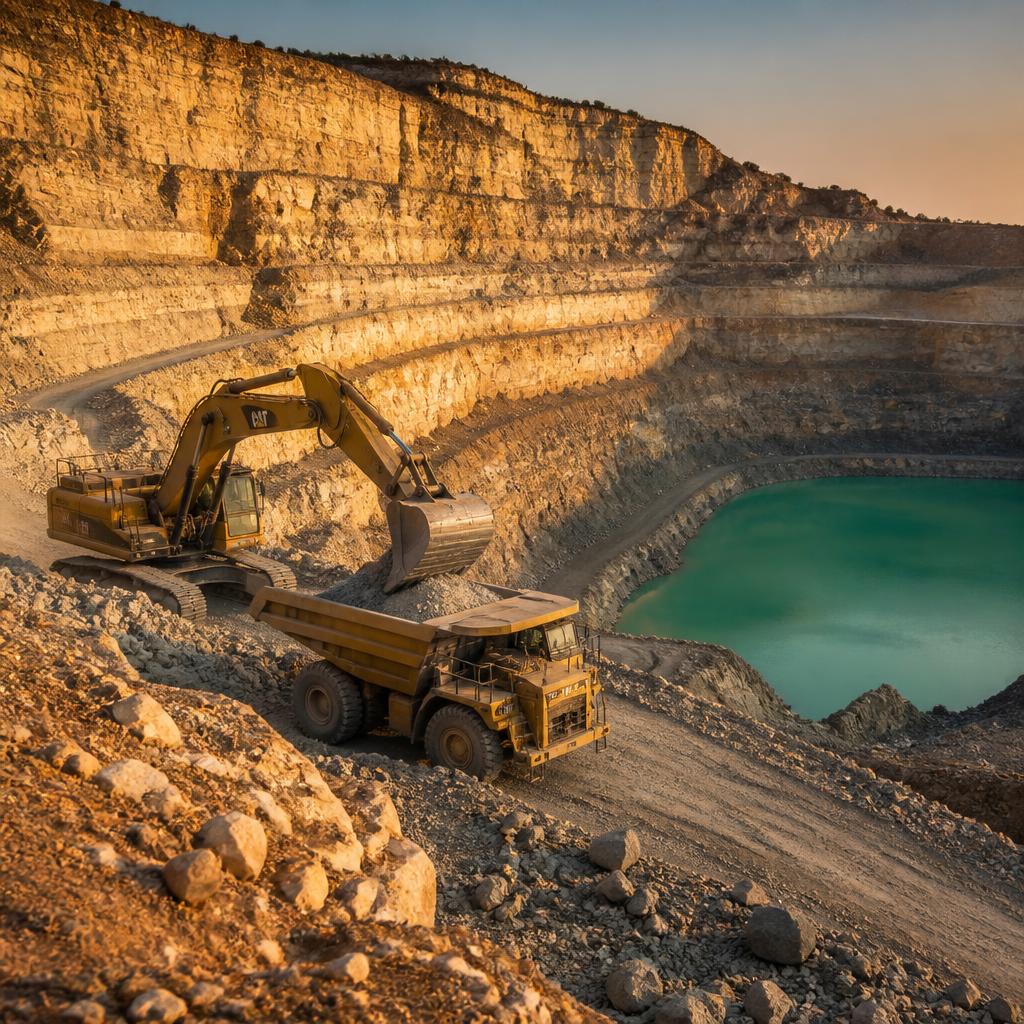
To quarry limestone is to cut or blast limestone rock from the ground for cement, concrete, steel making, and soil treatment. Most employ drilling, carefully designed explosives and huge crushers to shatter and size the stone.
Today’s quarries track dust, noise and water run-off with transparent rules and data. To understand how quarrying limestone influences construction, industry, and local land use, the following sections examine processes, effects, and protections comprehensively.
Understanding Limestone
Limestone lies at the core of many quarrying ventures due to its abundance and functional value. It is a sedimentary rock consisting primarily of calcium carbonate (CaCO₃), originating from seashells, microorganisms, and chemical precipitates on ancient ocean beds. Over millions of years, these carbonate beds compact and cement into stone that can be crushed into aggregate, burned for lime, or cut into blocks. Knowing what it is like is the initial step in any serious strategy to mine it.
Composition
Most limestone is calcite, a crystalline form of calcium carbonate, with aragonite as a less stable related form that can later convert to calcite during burial. In certain deposits, particularly where magnesium-rich waters circulated, some of the calcite is chemically replaced by dolomite, resulting in dolomitic limestone that acts somewhat differently in processing and application.
Natural limestone is never pure white calcium carbonate. Clay minerals, quartz sand, and fine silica dust are common impurities that move the color toward gray, beige, or brown. Organic matter can blacken the rock, or iron oxides can lend yellows or reds. These impurities influence not only color but also strength, porosity, and reaction to heat and chemistry in cement or lime kilns.
Under the microscope, limestone reveals a jumble of fossil debris, skeletal grains from corals and mollusks, and carbonate mud that drapes the spaces between the larger grains. This internal texture dictates how the rock breaks, how it polishes, and whether it is dimension-stone-block extractable or primarily for aggregate.
Chemically, most commercial limestones are composed of 90 to 98 percent calcium carbonate, up to approximately 5 to 10 percent magnesium carbonate, and small amounts of silica, alumina, iron oxides, and other trace elements. These percentages direct which deposits supply cement plants, which go to agriculture, and which are set aside for higher-purity industrial use.
Properties
Important physical properties for quarry planning are density, porosity, compressive strength, and solubility. Limestone density can vary but typically is in the 2.6 to 2.8 tonnes per cubic meter range and can range from tight, low-void stone to open, highly porous beds. Its uniaxial compressive strength typically varies from approximately 30 MPa for a weaker, more porous stone up to around 150 MPa for compact, ‘high quality’ rock.
Its indirect tensile strength is much lower, which is why hydraulic splitting and wedge cuts are effective when separating blocks. Chemically, limestone dissolves in weak acid, including mildly acidic rain water. Thus, it features prominently in karst topography with caves, sinkholes, and underground streams.
This same solubility forms the basis of its use in neutralizing acidic soils, industrial effluents, and flue gases. Because it stores carbon in mineral form, limestone is a long-term carbon sink in the global carbon cycle. When it’s burned to create lime or clinker, that stored CO₂ gets released. A number of industrial plants now view capture and reuse as a means to balance this cycle.
Various grades have varying workability and durability. Dense, fine-grained limestone can be cut into blocks, polished, and used for facades or monuments, whereas more fractured or impure stone is best used as aggregates or raw feed for cement and lime. This is the reason why there are different quarries for aggregates, for lime or cement raw material, and for dimension stone.
Uses
- Crushed aggregate for roads, rail ballast, and concrete
- Raw feed for cement and quicklime production
- Flux in steel refining to bind impurities into slag
- Ingredient in glass production to supply calcium
- Soil conditioner in agriculture to control acidity
- Filler in paints, plastics, paper, and roofing products
- Filter media and neutralizing agent in water treatment
- Building stone for facades, flooring, and monuments
In reality, limestone is a premium natural aggregate resource. Here in the US, it comprises roughly 42% of all domestic aggregate production. Some regions, such as Florida, show how concentrated this can be. The state ranks second in limestone aggregate production and fourth in consumption, with large open-pit quarries feeding road, building, and coastal projects.
Above bulk applications, handpicked stone becomes countertops, tiles, and cladding on public buildings, with dimension-stone quarries mining layers that cleave cleanly and are strong enough for big blocks. Across all of this, the production chain still follows the same two main phases: quarrying to extract suitable rock and processing to crush, size, finish, or refine it for final products.
The Process of Quarrying Limestone
Quarrying limestone removes rock from premium natural reserves and transforms it into products like aggregates, raw material for lime or cement, or blocks for dimension stone. In practice, the full limestone production chain splits into two broad phases: quarrying in the rock mass and then processing into final, saleable products.
1. Site Evaluation
Site work starts long before any rock is moved. Geologists and engineers study regional maps, outcrops, and old drilling records to confirm that a thick, continuous limestone bed is present. They run test drilling and core sampling to check bedrock quality, measure layer thickness, and estimate mechanical properties such as uniaxial compressive strength, which for limestone often ranges between 30 MPa and 150 MPa.
Teams evaluate how close the site is to roads, rail, and end users since transport cost can define if a quarry is viable. A deposit near a city may work well for aggregate, while high-purity limestone for cement, lime, or dimension stone often sits farther from markets but justifies longer hauling due to higher value.
Engineers map fracture sets, joints, and faults and sample the depth and nature of overburden. They record groundwater elevations and flow lines to understand how quarries or underground chambers could alter nearby hydrology. Drone photogrammetry and GNSS machine control provide high-resolution surface models and enable iterative planning as the quarry floor lowers over time.
A simple site selection checklist usually covers: limestone thickness and purity, rock strength and fracture pattern, overburden depth, access to roads or rail, distance to markets, groundwater and surface-water sensitivity, biodiversity and habitat constraints, potential for noise and dust, and space for future expansion and eventual land restoration.
2. Overburden Removal
After a site is approved, soil, vegetation, and loose rock overburden above the limestone are stripped with excavators, bulldozers, and sometimes scrapers. This ‘overburden’ is not waste; it is put into planned mounds for reuse in land reclamation, slope cover, and habitat rebuilding.
Operators strive to minimize the disturbed footprint, maintain buffer zones and phase stripping so bare ground is exposed for the minimum practical duration. Basic initiatives like silt fences, sediment ponds and seeded berms mitigate erosion and shield local streams from fine sediment and changed runoff.
3. Rock Extraction
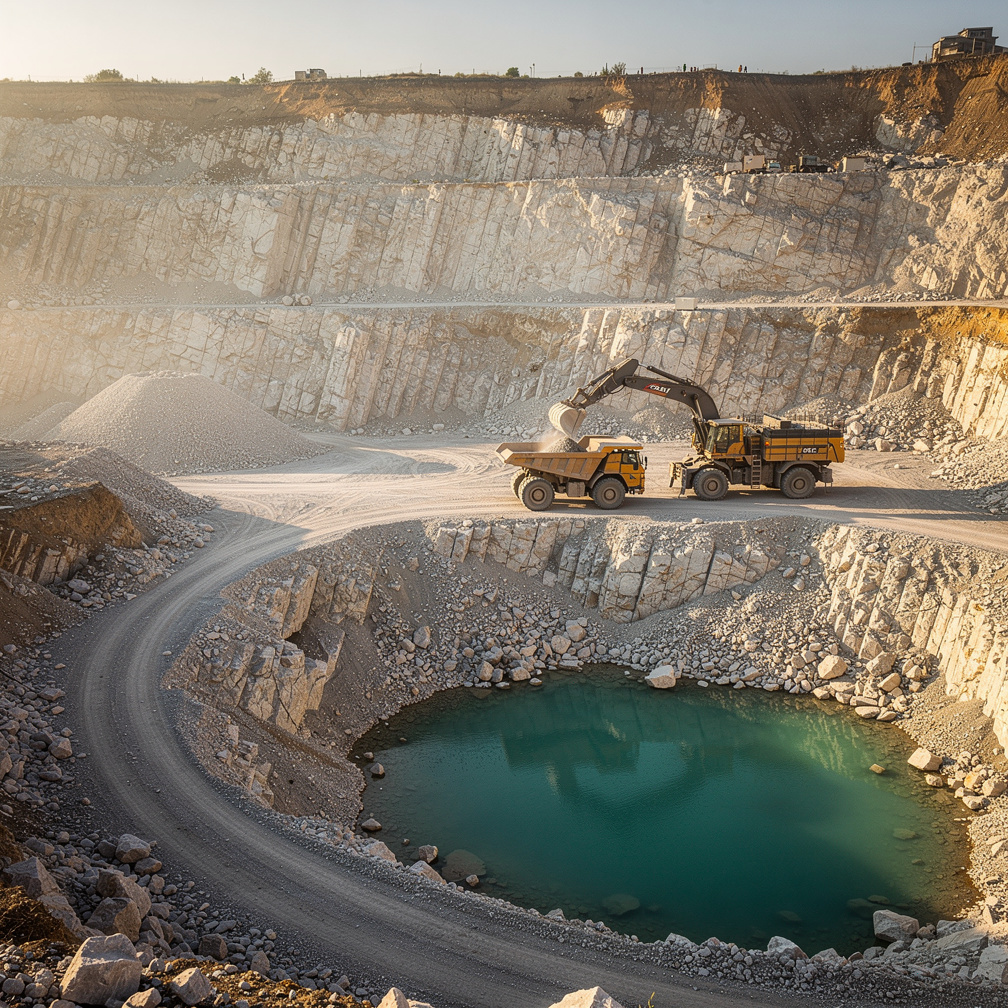
Rock extraction is when surface (open-pit) and underground mining definitively part ways. In open pits, drilling rigs position blast holes in rows along the quarry face. In underground workings, miners drive access ramps, rooms, and pillars, blasting rock in a grid that leaves room supports in place for the roof. For either, the objective is to separate blocks neatly while maintaining stability on the pit wall or underground drifts.
Depending on product and rock behavior, crews employ controlled blasting, mechanical cutting or hydraulic splitting. The indirect tensile strength of limestone is much lower than compressive strength. Hydraulic splitters and rock wedge splitters take advantage of this by pushing into drilled holes and forcing a clean crack path for dimension-stone blocks or for more precise breakage in tight areas.
Extraction plans vary for aggregate quarries, raw material for lime or cement, and dimension-stone quarries. Aggregate and cement plants typically take smaller chunks, so they prefer effective, high-frequency blasting. Dimension-stone locations pursue uniform, flaw-free blocks suitable for converting into slabs, often from thin zones of extremely high-grade material at certain sites, and thus depend more on precise drilling patterns, wire saws, and wedges.
In each case, foremen monitor recovery rates, bench stability, and waste volumes, and then adjust drilling patterns, blast charges, or splitting patterns to increase yield and minimize unusable offcuts. Limestone mining carries risks such as flyrock, wall failure, dust exposure, noise, and changes to groundwater and biodiversity. Safety rules, blast exclusion zones, and continuous slope monitoring are in place to keep crews, local communities, and ecosystems safe during this heavy part of the work.
4. Primary Crushing
Once extracted, haul trucks or loaders transport rock to the primary crusher, usually a jaw or gyratory unit the size of which is capable of taking the biggest blocks. The type of machine used depends on the hardness of the limestone. Wetter or softer stone may require different liner designs and feed control to prevent caking or blockages.
Crushing creates a lot of dust, so operators employ sprays, enclosed transfer points and occasionally bag filters to maintain low airborne levels for workers’ health as well as that of nearby residents. Output is checked to meet target size distributions for construction aggregate, cement feed or further stone shaping because downstream efficiency relies on having the proper input grading.
5. Final Processing
Final processing converts crushed stone into finished products. Screens separate material by size and washing systems eliminate clay and fines that affect concrete, asphalt, or kiln operation. Conveyor circuits direct each fraction to stockpiles or additional processing.
For chemical applications, kilns can fire limestone into lime, or mills pulverize it into fine powdered limestone for flue-gas scrubbers, fertilizers, or fillers. Dimension-stone blocks end up at saws, polishing lines, and cutting tables that transform raw blocks into slabs, tiles, and custom pieces for architecture and public spaces.
On these paths, quality control monitors grade, strength, purity, and finish. Samples are tested to ensure they meet building and industry standards, and ongoing tracking of fuel, water consumption, and waste underpins more efficient, lower-impact processes. Limestone quarrying can impact air, water, and local flora and fauna if not tightly controlled from end to end.
Environmental Footprint
Limestone quarrying supports cement production, and cement consumption is projected to nearly double by 2050. How quarries are designed and operated will greatly influence future environmental footprints, from local dust and noise to global climate strain.
|
Impact Area |
Primary Effects |
Main Drivers |
Typical Mitigation |
|---|---|---|---|
|
Air quality |
Dust, fine particulate exposure, diesel emissions |
Drilling, blasting, crushing, haul trucks |
Water sprays, filters, enclosure, cleaner fuels |
|
Water systems |
Lowered groundwater, polluted runoff, habitat change |
Dewatering, fuel spills, sediment transport |
Drainage design, spill control, treatment ponds |
|
Land disturbance |
Habitat loss, soil erosion, visual scarring |
Pit expansion, overburden stripping |
Progressive rehab, re‑vegetation, landform replication |
|
Noise & vibration |
Nuisance, stress, structural and ecosystem impacts |
Blasting, crushers, heavy equipment |
Time limits, buffers, monitoring, community agreements |
Across all four spheres, the fundamental challenge is to balance increasing mineral need with strong regulation of pollution, habitat destruction and permanent land‑form transformation. It is also essential to connect quarrying practice with broader initiatives like the European Green Deal and national low‑carbon targets that propel the cement pipeline toward greener, circular approaches.
Air Quality
Air affects are focused on dust and exhaust. Drilling, blasting, loading, hauling, and crushing fracture limestone into smaller fractions and emit dust particles that remain airborne. If left unmanaged, these particles blow off-site, settle on crops and roofs, and increase PM₁₀ and PM₂.₅ levels for nearby communities and workers.
Most quarries today blend water sprays, enclosed conveyors and dust collectors on crushers to maintain emissions below allowable rates. Well-designed systems situate spray bars at transfer points, utilize bag or cartridge filters on critical equipment, and maintain haul roads damp and compacted.
Cutting idling, switching to electric crushers, and using low-sulfur fuels reduce the diesel exhaust footprint. Health risk hails from prolonged exposure to fine dust that can irritate eyes and lungs and worsen existing respiratory disease.
Frequent air monitoring on the quarry boundary, medical checkups for personnel, and strict PPE regulations maintain risk at an acceptable level for both employees and local populations.
Water Systems
Quarrying can lower groundwater levels when pits are so deep they require ongoing pumping to remain dry, which can impact wells, springs, or wetlands that local users depend on. Surface water can change course where pits and haul roads intersect natural drainage lines.
Runoff from exposed rock and soil can deposit fine sediment in streams or ponds. If fuel storage and workshop areas are mismanaged, oil and chemical spills can contribute hydrocarbons or metals. To avoid this, sites construct lined ditches, sediment ponds, and oil-water separators and store fuel on sealed, bunded aprons.
Regular water sampling upstream and downstream of a quarry tracks pH, suspended solids, and basic chemistry. Simple surveys of fish, invertebrates, and plants in nearby rivers provide an early indication of stress on aquatic habitats.
Land Disturbance
Limestone mining typically requires expansive land to accommodate pits, overburden dumps, and roads. Those impacts can persist for decades after shutdown. This clears soils and vegetation, eliminates plant and animal habitat, and can disrupt species’ movement corridors, a factor that contributes to the biodiversity loss commonly associated with limestone mining.
Engineers attempt to reduce this footprint by first mapping sensitive habitats, then phasing the pit in smaller blocks allowing some areas to be rehabilitated while others remain active. Slope design, soil stockpiling, and drainage layout seek to minimize erosion and prevent unstable faces.
Reclamation plans may restore sites to farm, forest, wetland, or conservation uses. Some of these closed quarries actually become artificial lakes with public access, while others are home to solar farms or nature reserves.
As cement is still a big consumer of limestone, its carbon footprint can be reduced by transitioning to low-carbon binders and additional recycled aggregates. Several traditional cement manufacturers nowadays tie their quarry restoration initiatives to broader circular construction efforts.
Noise and Vibration
Blasting, drilling, crushing and truck traffic make noise for workers and neighbors, particularly where quarries nestle near towns or villages. We routinely measure sound at the boundary, schedule the noisiest work during static daytime windows, and use berms, vegetated buffers, or acoustic panels to block line of sight to the noisiest equipment.
Blasting causes ground vibration and air overpressure. These are monitored with seismographs in surrounding structures and within sensitive areas like groundwater monitoring wells or protected habitats. By tuning blast charge size, timing and pattern, vibration can be kept under agreed limits and still break rock efficiently.
Open communication with the local community is key. Sharing blast calendars, complaint channels, and monitoring results helps build trust and shows how site-level actions fit into broader efforts to cut the construction sector’s footprint by using less primary rock and more alternative, low-carbon materials in cement and concrete.
Regulations and Worker Safety
Regulations in limestone quarrying center on two linked goals: protect workers and reduce damage to land, water, and air. Safety rules and environmental laws work together, and both lean on two main drivers: legal duty and moral duty, backed by human fear, care, and experience that shape how people think about risk at work.
Permitting
Permitting starts before a single block of limestone is cut. Operators usually need land use approval, an environmental impact assessment, and a formal quarry license that covers the full life of the site, from stripping topsoil to final reclamation. This package will often describe pit layout, maximum depth, haul road design, blasting plans, water use, and dust and noise controls so regulators can judge if the project fits local, regional, and national rules.
Good permit files don’t linger vague. They specify extraction methods, including bench height, slope angle, and blasting sequence, and pair each with a mitigation measure, such as mist sprays on crushers, berms on haul roads, or buffer zones near residences.
Reclamation plans describe how to contour benches, cover overburden, and replant with native species or make the land ready for new use, such as industry, grazing, or wetlands. Outreach to regulators is not an initial step. Site managers respond to inquiries, accommodate inspections, and file periodic reports on volumes extracted, water quality, and design modifications.
They monitor permit renewals and changes so blasting restrictions, operating hours, and waste handling requirements remain up-to-date as the quarry expands or changes.
Compliance
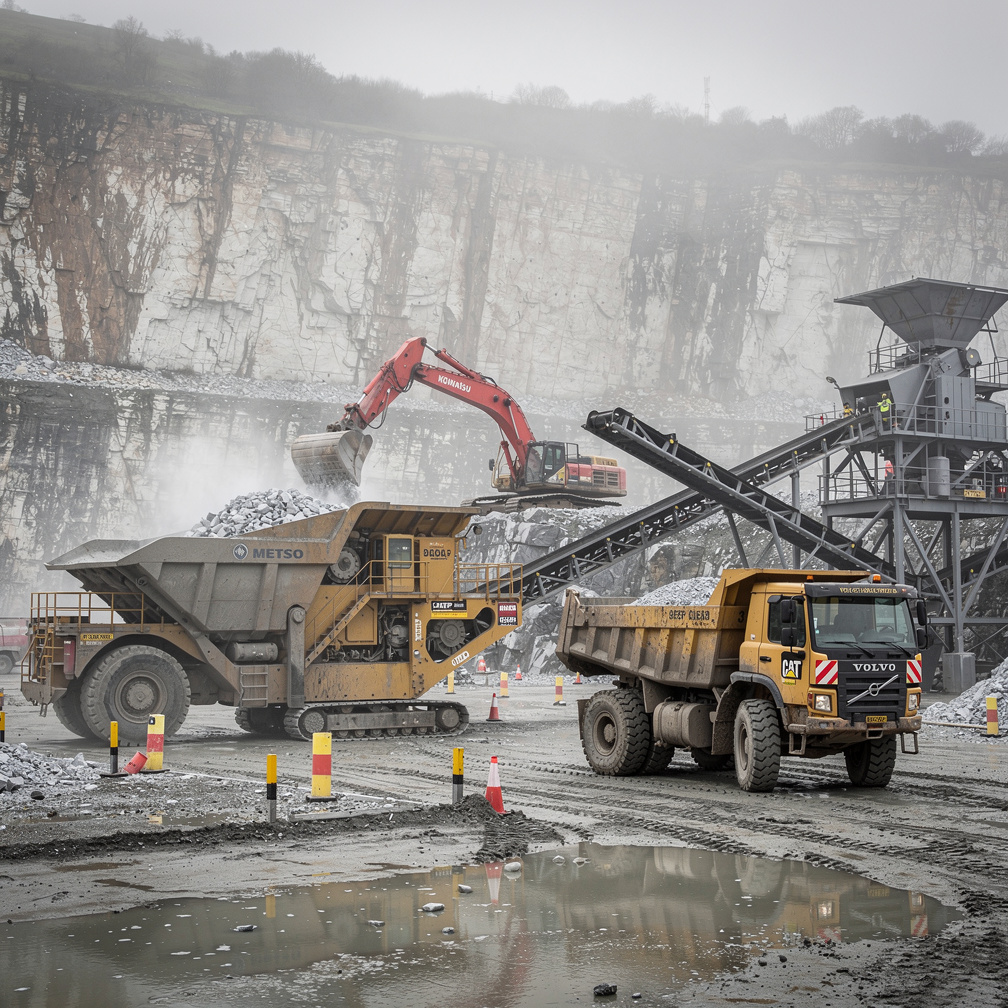
Compliance means transforming permit commitments into practice on the ground every day and staying abreast of public health, safety, and environmental regulations issued by agencies and industry organizations. This ranges from dust limits to vibration and noise caps, machine guarding standards, and rules around slope stability and traffic management within the pit.
Routine audits and workplace inspections are the supporting structure here. Internal teams and outside inspectors walk haul roads, scaling areas, crushers, and workshops to identify unsafe acts, inadequate signage, sloppy housekeeping, or absent guards.
Studies of industrial accidents show why this matters: about 88% of work accidents relate to unsafe movements or behavior, 10% relate to unsafe conditions, and only 2% relate to events that are hard to avoid. Inspections must look at both people and the physical setup.
Once a gap emerges, response should be rapid and targeted. A broken access ladder is repaired, a loader operator retrained, and traffic flow redesigned. Managers track findings, fixes, and training logs and publish them for review, which builds trust with regulators and provides a data trail for subsequent risk analyses.
A set of, say, 50 identified risks may show that 60% are high, 36% are medium, and 4% are low, indicating what to fix first.
Worker Health
Worker health in limestone quarries is centered on dust, noise, vibration, heavy gear and explosives. Basic PPE like dust masks or respirators, earplugs or earmuffs, helmets, high-visibility vests, gloves and safety boots is a must because good PPE and clear training combined reduce accident and injury rates significantly.
Training is more than an induction talk. Depending on the jurisdiction, MSHA or an equivalent body mandates annual training on hazard identification, emergency response, and safe equipment usage. That includes blasting signals, misfire drills, lockout-tagout for crushers and conveyors, and safe approach distances for excavators and haul trucks.
Risk analysis undergirds this work. Teams map out steps, score each hazard and determine controls, which is similar to the reasoning behind HACCP in food plants that tests critical points in production to reduce risks. For a quarry, these critical points might be edge work near high walls, blasting, confined space entry or crusher maintenance.
More modern sites might even use drones to scan benches and check pit stability, providing more input into the risk model. Emergency response closes the circle. Sites have first-aid stations, rescue gear and explicit evacuation plans in case of fire, collapse or life-threatening injury and practice drills on a regular basis.
Regular safety audits and inspections then test if these plans, the PPE use and exposure monitoring for dust, noise and vibration are working in real life, which feeds into a culture of steady, step-by-step safety improvement.
Economic and Community Impact
Limestone quarrying lies close to everyday life and local budgets, so its economic and community impact extends well beyond the quarry fence.
Local Economies
Limestone quarrying frequently forms the basis for regional economies because it connects low-cost raw material with high-volume need. One cluster of limestone aggregate operations can sustain more than 10,000 jobs and approximately $550 million in wages and benefits, including equipment operators, engineers, lab technicians, mechanics, drivers, and office staff.
These tend to be relatively good, full-time jobs, as the need for aggregate for roads, housing, and public projects never goes down to zero, even during economic lulls. Beyond payroll, the limestone aggregate industry can generate over $70 million in tax revenues for states and local communities, which then support school budgets, road repairs, and public services.
The economic impact ripples throughout the supply chain. Quarries depend on heavy trucks, rail connections, suppliers of explosives, maintenance contractors, fuel suppliers, and survey and testing services. Each of these sectors receives consistent business as long as the quarry remains operational.
Take Florida’s Lake Belt Region, for instance, where operations provide nearly 50% of all limestone used in the state for road construction, maintenance, and a host of commercial and industrial projects. Transport and logistics companies in that corridor rely on consistent quarry deliveries.
For locals, limestone continues to be one of the cheapest and most effective means of obtaining aggregate. It nourishes concrete plants that cast slabs for houses and medical centers, creates base courses for highways and cradles the frame of high-rises, mega-malls and campuses.
Because the material is proximate to construction sites, transport distances shrink, which helps explain why Florida boasts some of the lowest construction costs in the country.
Key economic contributions of limestone quarrying to local areas include:
- Direct employment and stable wage flows
- Contractor and supplier demand for goods and services
- Reliable, low-cost aggregate for public and private projects
- Tax revenue that supports local infrastructure and services
Community Relations
Quarry operators labor under intense public oversight, so professional community relations count nearly as much as output statistics. Most sites conduct routine information meetings with residents and local governments, disseminate layman-accessible blasting schedules, and publish monitoring data on dust, noise, and groundwater to minimize uncertainty.
When people know what is going on and when, they can plan their schedules and pose questions in advance, not just when a challenge emerges. Issues tend to group around noise from crushers, dust on local roads, truck traffic through neighborhoods and potential blast effects on buildings and wells.
In response, conscientious operators redesign haul routes, install covered conveyors, employ dust suppression sprays and schedule blasts during predictable daytime windows. Limestone companies in sensitive regions report that they do everything they can to reduce blasting impacts socially and economically, such as by employing smaller, more frequent charges and real-time vibration monitoring.
A number of quarries funnel some of their income into tangible community efforts. This may be funding local science and engineering education programs, co-sponsoring road improvements near the site, or supporting the construction of sports fields and public spaces with donated aggregate.
To maintain trust, operators establish grievance mechanisms like hotlines, site visits, or joint community-operator committees where residents can register complaints and monitor how they are addressed, from initial reporting through to resolution.
Land Reclamation
Starting a project, serious operators now map out how to return or repurpose the land once extraction concludes, instead of relegating reclamation as an afterthought. A reclamation plan plots ultimate slopes, water levels, soil depth, and road access and coordinates them with local development and ecological objectives.
While mining, overburden and topsoil are stripped, stored separately and later reused to cover regraded benches and pit floors so vegetation will grow again and slopes remain stable. Once the final blocks or aggregate loads roll off the site, ex-limestone quarries can transition into a variety of purposes.
Some fill partly with water and become controlled lakes used for recreation or water storage. Others become parks, wildlife corridors, or hybrid zones with greenspace intermingled with light industry or logistics hubs that leverage existing transport connections. It depends on what your regional plans are and how deep and wide the final hole is.
Long-term success requires stewardship, not just a handoff. Teams monitor vegetation coverage, erosion, groundwater quality and habitat use, then modify management with new plantings, drainage modifications or access restrictions.
When this cycle works, a quarry site transitions from a temporary source of cheap aggregate to a multi-generational asset that continues to serve the community even after mining is finished.
The Future of Quarrying
Limestone quarrying going forward is located at the intersection of growing demand, stringent environmental constraints, and rapid technological advancement. Cement demand will nearly double by 2050, and limestone products and aggregate continue to be nearly irreplaceable in everything from concrete to glass and steelmaking. This pressure is propelling the industry to cleaner extraction, smarter processing, and closer connections to circular economy models that reduce waste and conserve local ecosystems.
Sustainable Practices
Energy use will remain in the spotlight. Quarries are already transitioning to electric haul trucks, variable-speed drives on crushers, and high-efficiency motors to reduce kilowatt hours per tonne. Some European sites operate fixed plants on 100% renewable electricity from on-site solar or longer-term power purchase agreements and employ hybrid or battery loaders for short hauling, reducing emissions and noise in proximity to communities.
Waste reduction is another central thread. Fines, overburden, and off-spec stone that used to go to spoil heaps now enter side streams as filler in asphalt, soil conditioners, or feedstock for low-carbon binders. It’s not just pioneers; innovators are turning quarry dust and cement kiln byproducts into alternative cements and blocks, repurposing what otherwise would have been wasted as input.
This is a great complement to the industrywide drive to bring circularity mainstream in construction. With its biodiversity work getting more systematized, some operators create benches, ponds, and buffer zones that serve as habitats. They then schedule staged reclamation so sections of a quarry are rewilded even as others remain operational.
Once closed, these sites can serve as wetlands, grasslands, or recreational areas, provided early in the design are soil stockpiling, native species inoculation, and long-term monitoring. To keep this credible, quarries set measurable goals such as energy per tonne, dust levels, share of recycled inputs, and restored hectares per year.
They report on them in sustainability reports, frequently aligned to international standards, that allow regulators, neighbors, and investors to keep tabs on real-world progress.
Technological Advances
Digital tools are transforming how the some 400 working limestone quarries across Europe schedule and manage their sites. High-resolution drone surveys, LIDAR, and 3D geological models map reserves, optimize blast design, and reduce over-break, saving energy in crushing and unusable waste.
On the ground, precision drilling rigs, diamond wire saws, and optimized crusher circuits seek to increase throughput while reducing wear and accident risk. Improved fragmentation through precision blasting results in reduced crusher jams and more consistent product. This enables downstream cement plants to operate at steady kiln conditions with reduced specific fuel consumption.
Real-time monitoring represents another high-growth area. Networks of sensors monitor dust, vibration, and water quality in and around the site. Data dashboards inform operators when readings approach permit limits, allowing them to adjust blasting windows, misting systems, or traffic flows before complaints develop.
This data trail comes in handy as proof during permit renewals and impact reviews. R&D is still seeking new ways to process and use limestone, from carbon-cured aggregates that lock some CO₂ to superfine limestone additions that can replace a portion of clinker in cement.
It’s a very promising solution because it already exists at scale, often at close to zero additional cost, but standards and policies that would drive large-scale uptake still lag, which impedes adoption.
Circular Economy
Circular thinking goes from niche to normal in limestone. Reclaimed concrete, masonry, and asphalt are crushed and mixed with limestone to produce base layers, backfill, or new concrete, reducing reliance on virgin rock. In landscaping, offcuts and smaller pieces from dimension stone quarries see second lives as gabions, garden walls, or erosion control.
Closed loop is about keeping more material in use for more time. A cement plant adjacent to a quarry, for instance, can recycle kiln dust into blended cements and accept construction and demolition debris as an alternate raw mixture. That decreases the portion of material that needs to be sourced from fresh blasting and hauling.
Partnerships are critical to this loop. Quarries partner with ready-mix producers, prefab plants, and recyclers to organize take-back schemes, grade recycled aggregates, and align local supply with demand. For young engineers, planners, or policy professionals, these cross-sector projects are where technical skills and systems thinking collide.
Leading producers are already running pilot initiatives: high clinker-substitution cements based on limestone fillers, platforms that trace aggregate origin and recycled content, and restoration projects that lock in biodiversity gains.
Policy discussions such as the trilogues underway related to the European Green Deal and ecodesign rules provide an opportunity to embed these practices into market standards so that sustainability becomes the norm for cement and other limestone-based products.
Conclusion
Quarrying limestone is something that runs deep through many aspects of our modern lives. Roads, homes, glass, steel, and even clean water sometimes begin in a rock face that crews slash, chisel, and blast bit by bit. It seems like a rough process, but every blast, every haul truck, and every crusher step is bound to tight plans and strict regulations.
Real gains come from difficult tradeoffs. Limestone can sustain livelihoods, finance community initiatives and fuel crucial supply chains. It can scar land, stress air and water, and try towns. Tough regulations, equitable compensation and sincere communication with townspeople go a long way around here.
As a next step, choose a local quarry near you, check its reports, and note how it aligns with the concepts in this guide.
Frequently Asked Questions
What is limestone and why is it important?
Limestone is a sedimentary rock composed primarily of calcium carbonate. It matters for cement, concrete, road base, and building stone. It’s employed agriculturally to neutralize soil acidity and industrially in steelmaking and water treatment.
How is limestone quarried?
Limestone is drilled, blasted and broken into lower-sized blocks. Huge machines dump the rock into trucks or conveyors. It is then crushed, screened and occasionally washed. Each step is carefully planned to maintain the safety and productivity of the site.
What are the main environmental impacts of limestone quarrying?
Major effects are dust, noise, landscape modification and habitat destruction. Water use and runoff can impact local streams. Today’s quarries mitigate these effects with dust suppression, noise walls, responsible water use, and land reclamation plans.
How are quarry workers kept safe?
They adhere to rigorous safety regulations. Workers are trained, given protective equipment, and receive frequent medical exams. Sites implement defined traffic routes, machine checks, and explosives regulations. Punctual inspections and hazard analyses aid in avoiding catastrophes and harm to health.
Can a limestone quarry benefit the local community?
Yes. Quarries generate local employment, sustain suppliers and provide tax income. Some pits eventually turn into parks, lakes and nature preserves. This benefit is maximized when operators engage proactively with communities and adhere to robust environmental and safety regulations.
What is being done to make limestone quarrying more sustainable?
Operators with modern drilling, blasting and crushing cut fuel use and emissions. Some quarries recycle water and reclaim land while they mine. Some track biodiversity, invest in renewables, and implement long-term restoration and climate plans.
Will we run out of limestone for construction?
Limestone is found in great quantity and deposits worldwide are substantial. The key issues are local sources, shipping costs, and ecological constraints. Smarter resource planning, building material recycling, and design efficiency go a long way toward stretching existing limestone reserves.