
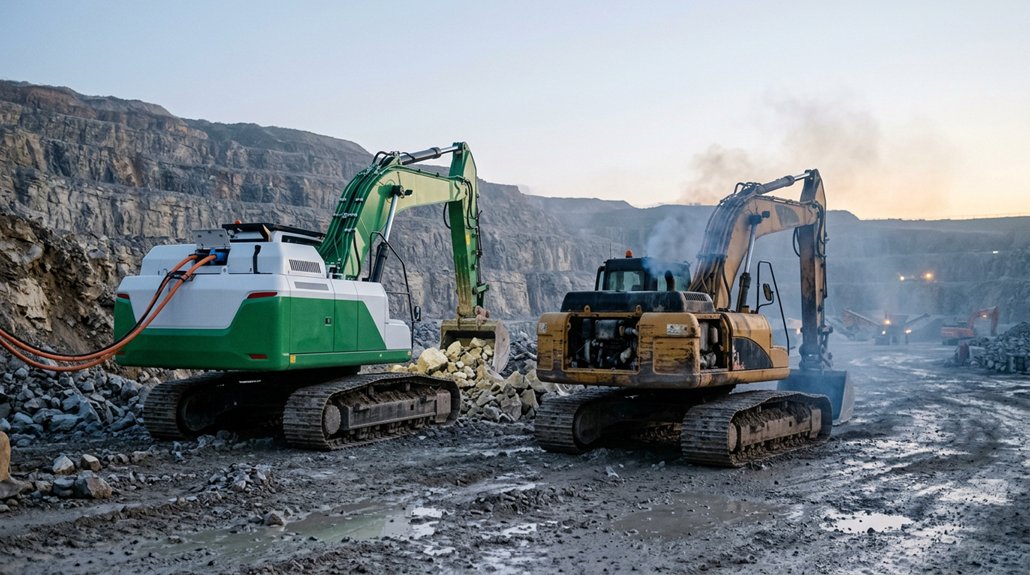
If you’re planning a UK quarry fleet, you can’t judge electric and diesel earthmovers on purchase price alone. You’ll need to compare duty cycles, payloads, gradients, shift lengths, charging or refuelling access, maintenance, emissions, and site constraints. Electric machines can cut noise and operating costs, while diesel still offers rapid refuelling and dependable high-power performance. The right choice may not be either-or—and your quarry’s daily workload will determine which balance works.
Key Takeaways
- Electric earthmovers suit predictable quarry cycles, frequent loading, short hauls, and reliable charging access, while diesel remains stronger for remote or variable operations.
- Compare total cost of ownership, including energy, financing, maintenance, operator training, downtime, residual value, and potential battery replacement.
- Electric fleets reduce onsite exhaust emissions and noise, but lifecycle benefits depend on electricity generation, battery manufacturing, and recycling arrangements.
- Quarry electrification requires early grid assessment, appropriately sized chargers, substations, cable routes, load management, storage, and allowance for future expansion.
- Diesel offers rapid refuelling and sustained high-power operation, but requires compliant engines, fuel storage, spill protection, deliveries, and emissions management.
What Should You Compare Before Buying?
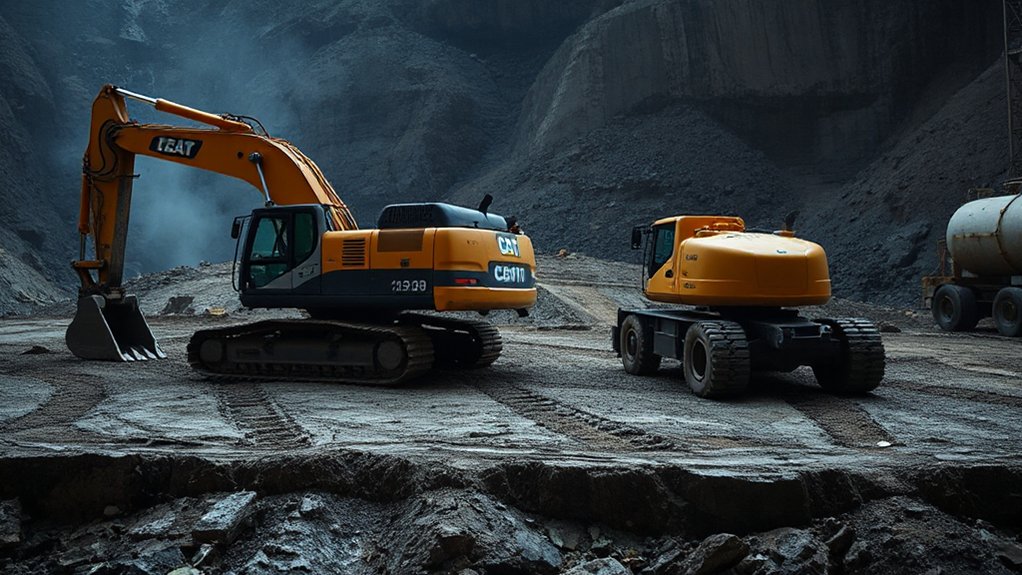
Before choosing electric or diesel earthmovers, compare the full operating profile rather than the purchase price alone. Define your required payload, duty cycle, annual hours, gradients, haul distances, and available charging or refuelling infrastructure.
Assess total cost of ownership, including energy prices, operator training, financing, residual value, and expected downtime.
Evaluate Battery technology by checking usable capacity, charging time, thermal management, warranty limits, replacement cost, and performance in cold UK conditions.
For diesel machines, compare fuel consumption, emissions compliance, after-treatment complexity, and fuel-storage requirements.
Review maintenance schedules for planned servicing, specialist skills, parts availability, battery inspections, hydraulic systems, tyres, and brakes.
Confirm each supplier’s technical support, telematics, warranty response, and local parts network.
Finally, model realistic utilisation scenarios so your choice reflects production demands, site constraints, and long-term resilience.
How Do Electric Earthmovers Perform in Quarries?
Electric earthmovers can perform effectively in UK quarries when their duty cycle matches the battery system and site infrastructure. You’ll see strong results on repetitive loading, hauling, and stockpiling routes, particularly where regenerative braking can recover energy.
Instant torque supports precise control on gradients, while quieter operation improves communication and reduces local noise.
Before deployment, map each machine’s hourly energy demand, charging windows, payload, and ambient temperatures. Fast chargers can restore productivity during planned breaks, but you’ll need electrical capacity, weather protection, and safe cable management.
Monitor state of charge, battery temperature, and energy consumption through telematics.
Good Battery longevity depends on controlled charging, suitable thermal management, and avoiding prolonged extreme states of charge.
Maintenance requirements are typically simpler, though you must inspect high-voltage systems, cooling circuits, tyres, brakes, and software. This discipline keeps availability predictable.
When Do Diesel Earthmovers Still Win?
Diesel earthmovers still win where quarries demand long, continuous shifts, high peak power, or rapid refuelling without grid upgrades. You can deploy them across remote benches, stockpiles, and changing work faces without waiting for charging infrastructure or transformer capacity. Their established hydraulic systems, high torque, and familiar controls support demanding extraction, loading, and haulage cycles.
You’ll also find straightforward refuelling through mobile bowsers, helping maintain production during extended operations or severe weather. However, plan carefully for fuel storage, exhaust management, and operator exposure.
An alternative fuel, such as hydrotreated vegetable oil, may reduce reliance on conventional diesel where equipment approval and supply allow. Expect maintenance challenges around injectors, turbochargers, cooling systems, and after-treatment equipment, particularly in dusty environments.
Choose diesel when operational flexibility and immediate energy density outweigh electrification constraints.
How Do Quarry Costs and Emissions Compare?
You’ll need to compare purchase and operating costs, including maintenance, downtime, and residual value, rather than focusing on the initial price alone.
Fuel versus electricity costs will depend on duty cycles, energy tariffs, charging infrastructure, and site power capacity.
You’ll also need to assess emissions and UK compliance requirements, as lower local emissions can reduce regulatory and operational risks.
Purchase And Operating Costs
Although electric earthmovers typically cost more upfront, they can reduce quarry operating costs through lower energy, maintenance, and emissions expenses. You’ll need to assess total cost of ownership rather than purchase price alone.
Battery technology affects capital cost, payload, operating range, warranty coverage, and eventual replacement planning. Electric drivetrains contain fewer wearing components, so you’ll generally face less servicing, reduced lubricant use, and shorter maintenance downtime.
However, you should budget for charging infrastructure, grid upgrades, software support, and specialist training. Compare each machine’s expected duty cycle, resale value, financing terms, and whole-life carbon cost.
Diesel equipment may offer lower initial expenditure and established maintenance networks, but its exhaust emissions can increase compliance requirements and site-control costs.
Build realistic maintenance schedules and measure energy consumption, availability, and productivity before committing.
Fuel Versus Electricity
When comparing fuel with electricity, calculate the cost per productive tonne rather than the headline price of diesel or grid power. Measure each machine’s energy consumption under your actual haul distances, gradients, payloads, and duty cycles.
Diesel loaders may offer rapid refuelling and predictable range, but fuel efficiency deteriorates during idling, cold starts, and partial loads.
Electric machines typically convert purchased energy more efficiently, while scheduled charging can reduce exposure to peak tariffs. Include charger demand, connection upgrades, and battery replacement allowances in your model.
Battery longevity depends on charge rates, operating temperatures, depth of discharge, and maintenance discipline; monitor these factors through telematics.
Compare productive availability, not just running cost: charging downtime can affect output unless you plan opportunity charging, spare capacity, or shift patterns around available power.
Recalculate costs as tariffs, utilisation, and diesel prices change.
Emissions And Compliance
Emissions and compliance costs extend beyond the machine’s purchase price: diesel earthmovers produce tailpipe NOx and particulate emissions on site, while electric models eliminate exhaust emissions at the point of use but still carry embodied-carbon and electricity-generation impacts.
You’ll need to assess each machine against current emission standards, site permits, and local air-quality requirements. Diesel equipment may require selective catalytic reduction, diesel particulate filters, low-sulphur fuel, and scheduled maintenance to sustain regulatory compliance.
Electric equipment can reduce monitoring, ventilation, and fuel-storage requirements, but you’ll need to document electricity sourcing, battery handling, charging infrastructure, and end-of-life recycling.
Compare emissions across the full operating cycle, including manufacturing, energy use, and maintenance.
In urban or enclosed quarry areas, electric machines can also reduce worker exposure, noise, and community complaints.
How Do You Plan Quarry Charging and Refuelling?
You’ll need to plan charging infrastructure around machine duty cycles, available grid capacity, and site access.
For diesel fleets, you’ll also need reliable fuel storage, delivery scheduling, and safe refuelling points close to active work areas.
Compare both systems against shift patterns, downtime risks, and future production demands.
Charging Infrastructure Planning
Plan quarry charging and refuelling around the production cycle, available grid capacity, and machine duty profiles rather than simply installing a few high-power chargers.
Map haul routes, loading areas, shift patterns, and parking locations to identify where electric machines can charge without disrupting output.
Specify chargers according to each machine’s battery technology, connector, charging curve, and turnaround time, then allow spare capacity for fleet expansion.
Ask your Distribution Network Operator about connection limits, protection requirements, reinforcement costs, and lead times early.
Use load-management software to stagger charging, reduce peak demand, and prioritise machines nearing dispatch.
Consider on-site solar, wind, or purchased Renewable energy, alongside battery storage, to improve resilience and control energy costs.
Design cable routes, substations, drainage, segregation, and maintenance access for quarry conditions.
Test the plan through operational modelling before construction.
Diesel Refuelling Logistics
While electric charging needs careful load management, diesel refuelling logistics depend on reliable fuel access, safe storage, and minimal disruption to quarry operations. Plan deliveries around production schedules, maintaining sufficient on-site capacity for weather-related delays, supplier disruption, or peak demand.
Position tanks on stable, accessible ground, away from drainage channels, and fit compliant bunding, spill kits, fire protection, and clear vehicle routes. Use calibrated pumps and digital records to monitor consumption, identify losses, and forecast refuelling frequency by machine, shift, and workload.
Schedule tanker access when haul roads are quiet, and train operators in safe dispensing and emergency procedures. Although diesel avoids battery lifespan concerns, inefficient idling and long travel to the tank increase costs and emissions.
Review usage data monthly, then adjust storage, delivery intervals, and fleet allocation accordingly.
Which Jobs Suit Electric or Diesel Earthmovers?
Electric earthmovers suit quarry tasks with predictable routes, frequent loading cycles, and access to reliable charging, such as extraction-floor loading, stockpile handling, and short-haul material transfer. You’ll gain quiet operation, zero tailpipe emissions, and precise control in enclosed or noise-sensitive areas. Match battery capacity to shift length, payload, gradients, and charging windows; under-sizing it can create costly downtime.
Diesel machines remain the practical choice for remote faces, irregular haul routes, heavy ripping, and continuous multi-shift work where charging access is limited. Their engine reliability and rapid refuelling support sustained output across changing locations and demanding ground conditions.
You should assess duty cycles rather than machine labels: record travel distances, idle periods, load weights, gradients, and daily hours. That evidence will show which powertrain suits each job, without compromising production or site safety.
Which Powertrain Fits Your Quarry’s Future?
Your quarry’s future powertrain should be selected against its expected duty cycles, infrastructure, and emissions targets—not current machine preference. Map operating hours, haul distances, gradients, payloads, idle time, and charging or refuelling access before choosing equipment.
Electric machines can deliver lower noise, zero tailpipe emissions, and strong low-speed torque, making them effective for predictable, intensive cycles near suitable grid connections. Battery technology is advancing, but cold weather, charging capacity, replacement costs, and grid upgrades still require careful planning.
Diesel remains practical for remote, variable, or multi-shift operations where rapid refuelling and maximum availability matter. However, modern engines and hybrid systems can improve fuel efficiency and reduce emissions.
You’ll often achieve the best long-term resilience through a mixed fleet, matching each machine’s powertrain to its duty rather than adopting one solution universally.
Frequently Asked Questions
Are Electric Earthmovers Safe to Operate Around Water, Dust, and Explosive Quarry Materials?
Yes, you can operate electric earthmovers safely around water, dust, and explosive materials when you follow manufacturer limits, sealed-system inspections, Water safety, Dust management, ventilation, isolation procedures, and quarry-specific risk assessments.
What Maintenance Qualifications Do Technicians Need for Electric Quarry Machinery?
You’ll need certified high-voltage training, manufacturer accreditation, and quarry safety competence. In this brave new world, master Battery technology diagnostics and Charging infrastructure procedures, then maintain isolation, inspection, and emergency-response standards.
How Does Battery Disposal or Recycling Work When Electric Earthmovers Reach End-Of-Life?
You’ll isolate batteries, prevent damage, and use certified contractors following documented Disposal procedures. Battery recycling recovers valuable metals; you’ll retain transfer notes, verify compliance, and never landfill, dismantle, or export packs without authorization.
Are Government Grants or Tax Incentives Available for Electric Quarry Equipment in the UK?
You can access Government incentives, but availability varies: check UK Clean Growth Funding, local schemes, and Enhanced Capital Allowances. Taxation policies may support electrification through capital deductions, reduced electricity costs, and business-rate relief. Verify eligibility annually.
How Do Electric and Diesel Earthmovers Affect Operator Comfort and Workplace Noise?
You’ll typically experience smoother operation and lower vibration in electric earthmovers, improving Operator ergonomics. Workplace acoustics also improve: electric drives reduce engine noise, while diesel machines demand hearing protection and stricter exposure controls.
Conclusion
Choosing between electric and diesel earthmovers depends on your quarry’s duty cycles, infrastructure, terrain, and production demands. Electric machines can cut emissions, noise, and maintenance, while diesel equipment still delivers rapid refuelling and dependable long-shift power. Don’t put all your eggs in one basket: a mixed fleet may provide the strongest balance of resilience, cost control, and compliance. Assess charging, refuelling, operator patterns, and total ownership costs before committing, then scale the right technology with confidence.